
Choosing the right transparent LED film can transform glass curtain walls, retail storefronts, corporate lobbies, or exhibition spaces into visually stunning experiences without sacrificing natural light or architectural aesthetics. As an LED display manufacturer, I will outline the key factors to consider when choosing a transparent LED film. Hence, your final selection meets your needs for viewing distance, content type, environmental conditions, budget, and maintenance expectations. We will also showcase how JRVISUAL’s StarLink transparent LED film products (P2.5, P3.91, P6.25, and P10) can be applied in real-world scenarios.
Transparent LED Film: First, Consider Viewing Distance and Pixel Pitch
First, when choosing a transparent LED film, consider the viewing distance and the type of content you plan to display. Pixel pitch directly affects perceived resolution.
Close-range/High-detail applications such as retail windows, museum display cases: Choose a smaller pixel pitch. JRVISUAL’s StarLink transparent LED films P2.5 and P3.91 provide ultra-clear detail and sharp text, making them ideal for close-range viewing and displaying fine content. If your content includes small fonts, product close-ups, or detailed animations, a P2.5 or P3.91 transparent LED film display will provide the clarity your customers expect.
Medium distances, such as shopping mall atriums and lobbies, and indoor advertising: P3.91 and P6.25 pixel pitches offer a balance of visual quality and cost-effectiveness. These pixel pitches deliver clear, legible text and eye-catching images from several meters away, without the added cost of ultra-fine pitches.
Long distances/Large facades such as exterior walls, large signs: P6.25 and P10 LEDs optimize cost-effectiveness while ensuring visual impact at long distances. For installations with viewing distances of tens of meters, the visual difference between P6.25 and P10 LEDs is negligible; in this case, brightness and viewing angle should be prioritized.
Transparent LED Film: Balancing Transparency and Visual Performance
Transparency is the main selling point of transparent LED films: it preserves natural light, maintains unobstructed views, and integrates seamlessly with glass architecture. However, “transparency” and “visual effect” are often difficult to balance. Bonded transparent LED display technology—such as the integrated LED lights and IC drivers used in StarLink transparent LED film—directly mitigates this trade-off.
Key considerations include:
Transparency/Transmittance: LED display suppliers should provide a percentage (e.g., 60%–90% visible light transmittance). Higher percentages preserve more natural light but reduce visual brightness; lower percentages increase contrast but may block more light.
Uniform LED Distribution: Consistent spacing produces a clearer image and reduces dark spots. StarLink’s streamlined design integrates LEDs and IC drivers into the film, delivering vivid and realistic image/video output while maintaining high transparency.
Adhesive System Performance: Transparent LED film adheres to the glass surface with a thin, uniform layer of adhesive. When choosing an adhesive, consider its resistance to UV exposure and temperature fluctuations, and its long-term adhesion without leaving residue. A high-quality adhesive should also support removal and replacement without damaging the glass.
Optical Treatment and Anti-Reflective Coating: Some transparent LED film displays include or are paired with anti-reflective films to reduce glare from indoor lighting and sunlight. This helps improve contrast and enhances viewing comfort in bright environments.
Because StarLink transparent LED film integrates LED lights and IC drivers into a single, streamlined design, it achieves exceptional transparency while maintaining an ultra-thin profile. This is particularly advantageous for storefronts and curtain walls that need to preserve natural light and external visibility.
Modular Construction, Ultra-Thin Profile, and Customization Flexibility
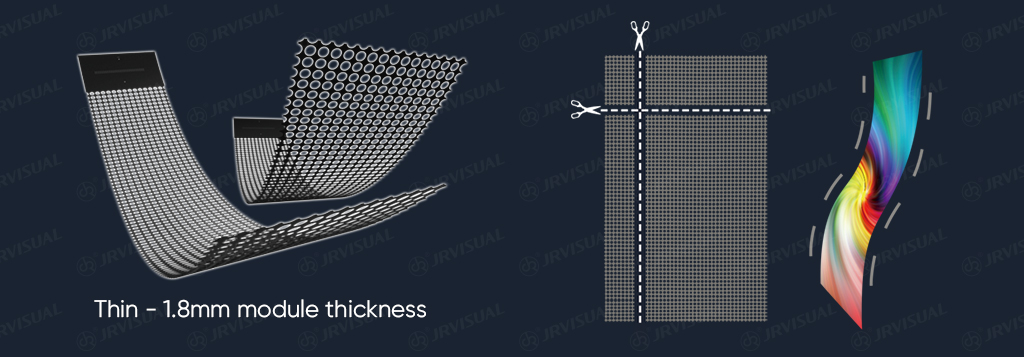
Module thickness and mechanical flexibility determine how well a transparent LED film display adapts to your building architecture. StarLink’s ultra-thin 1.8 mm module thickness is an industry-leading feature that offers several practical advantages.
Key advantages include:
Ultra-Thin Module Thickness (1.8 mm): The thin modules minimize visible profiles, maintain unobstructed views, and reduce wind load when installed on exterior glass. Thinner modules also allow for a flush appearance and easier integration with existing mullion or framing systems.
Flexible Modules and Curved Surfaces: StarLink standard modules are flexible and can be precisely cut. This is a significant advantage for curved glass, cylindrical atriums, or irregularly shaped installation environments, as rigid panels would force compromises in the installation design. The flexible transparent LED film modules conform smoothly to curved surfaces, avoiding seams and bulky, unsightly mounting frames.
Custom Cutting and Sizing: Modules can be precisely cut to the required dimensions, simplifying installation in irregular windows and allowing designers to match display contours to unique architectural patterns. For complex geometries, this can reduce labor and material costs for framing.
Therefore, StarLink’s ultra-thin and customizable modules are ideal for creative applications—such as embedded retail displays, curved interior partitions, or transparent LED film displays directly applied to curtain wall glass. The ease of customization and flexibility facilitates smoother design collaboration between architects, manufacturers, and integrators.
Installation, Structural Considerations, and Safety
A successful transparent LED film display requires more than just high-quality modules: it also requires a reliable installation solution that addresses glass type, framing, wind load (for outdoor applications), fire safety, and ease of maintenance. Planning reduces surprises and ensures long-term performance.
JRVISUAL Recommended Installation Checklist:
Glass Compatibility and Condition: Confirm whether your building uses annealed, tempered, laminated, or insulated glass units (IGUs). Some adhesives and installation methods are only suitable for specific glass types. For retrofit projects, ensure the glass structure is sound, free of delamination, and without previous surface treatments that might affect adhesion.
Installation Method: Applying adhesive directly to the glass is quick and easy, maintaining a clean and aesthetically pleasing look; however, in some cases, mechanical fastening systems (such as clips or rails) can provide redundancy and simplify maintenance. Hybrid systems combine adhesives with concealed anchors for added security.
Wind Load and Thermal Expansion: Transparent LED film displays installed on high-rise building facades must account for pressure differentials and thermal expansion. Due to StarLink’s transparent LED film’s ultra-thin and lightweight design, it reduces wind load compared to rigid enclosures; however, for outdoor installations above one story, a structural assessment is still mandatory.
Electrical Performance, Visual Performance, and Control System Considerations
Performance specifications determine whether a transparent LED film display can meet your content strategy. Don’t just evaluate pixel pitch; also compare brightness, refresh rate, grayscale, color calibration, viewing angle, and the control ecosystem.
Key Performance Indicators to Consider:
Brightness: Transparent LED films must overcome ambient light, especially in sunlit storefront environments. StarLink panels offer high-brightness options suitable for sunlit applications. For indoor applications, medium brightness (800–1,500 nits) is usually sufficient, while exterior facade applications may require up to 4,000 nits or higher.
Refresh Rate and Scanning: A high refresh rate (≥3840 Hz) reduces screen flicker on mobile phone cameras and improves video color stability. If the display will be used for filming or live streaming, a high-refresh-rate transparent LED film display solution should be prioritized.
Control System and Content Management: Transparent LED film displays can connect to standard media servers, video processors, and content management systems (CMS). Confirm that the supplier supports common protocols (HDMI, DVI, Ethernet, NovaStar, Linsn, or other controllers) and inquire about redundancy options for mission-critical signage.
Power Consumption and Thermal Management: Predict average and peak power consumption. Transparent LED film displays dissipate less heat than deep-cabinet displays, but the solar radiation heat from the external glass still needs to be considered. Proper thermal design extends LED lifespan and prevents color shift.
When evaluating suppliers, request performance data sheets that include measured brightness data at the final installation spacing, and demonstration videos showcasing the same content under similar ambient lighting conditions. A controlled on-site demonstration is the best way to evaluate the performance of a transparent LED film display in your actual environment.
Getting the Right LED Film for You
The right transparent LED film can directly impact visual effects, architectural integration, and user experience. By systematically evaluating pixel pitch based on viewing distance, balancing transparency and brightness using advanced adhesive transparent LED display technology, and prioritizing ultra-thin, flexible module design, you can ensure your transparent LED film display perfectly aligns with your project goals. JRVISUAL’s StarLink transparent LED film offers a variety of pixel pitch options, ultra-thin 1.8mm flexible modules, and a highly transparent integrated design, meeting the adaptability requirements of modern retail, commercial, and architectural applications.