LED displays have become a new canvas for modern architecture, perfectly blending technology and design to redefine the visual expression of buildings. From high-definition screens outside shops to clear traffic signs on the road, transparent LED film displays are suitable for a wide range of applications. However, faced with a wide variety of products on the market, how do you choose a transparent LED film display that meets your specific needs?
This time, we consider three aspects: environmental factors, performance requirements, and long-term value. Through in-depth analysis of your application scenarios and functional requirements, we ensure that the transparent LED film display you choose not only meets immediate visual expectations but also delivers reliable performance and cost-effectiveness over the long term.
Transparent LED Film Display for Retail Windows: Balancing Visibility and Transparency
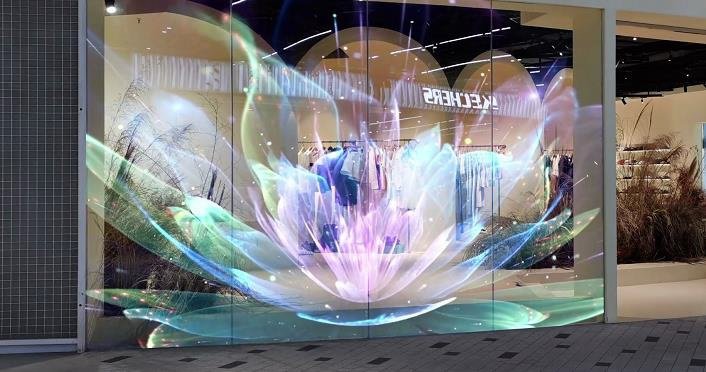
Retail storefronts need to strike a delicate balance between attracting customers’ attention and maintaining merchandise visibility. Transparent LED film displays must enhance the glass’s visual appeal without obstructing the view of the merchandise behind it.
StarLink transparent LED film displays are designed for this purpose. With over 50% light transmittance, StarLink glass allows natural light to pass through while also displaying vivid, realistic, dynamic content. This dual visibility is crucial for luxury brands, shopping malls, and experiential retail, as these venues require a clear display of both digital content and physical products.
Retail windows often face high ambient light and close-up consumer viewing. To meet these needs, StarLink offers four pixel pitches: P2.5, P3.9, P6.25, and P10, allowing you to choose the appropriate resolution based on your viewing distance. For example, P2.5–P3.9 is suitable for boutique windows viewed at close range, while P6.25–P10 is suitable for the facades of large shopping malls viewed from a greater distance.
Furthermore, StarLink’s brightness of up to 7,000 nits ensures that content remains clear and sharp even in direct sunlight. It can also be directly adhered to glass, achieving seamless integration without a bulky steel frame. This protects the architectural integrity of high-end retail spaces while reducing construction time and costs.
Outdoor Displays Require Considerations for Brightness, Weather Resistance, and Structural Safety
Outdoor glass curtain walls place extremely high demands on the operating environment of transparent LED film displays. The system must withstand sunlight, wind loads, high temperatures, and long-term UV exposure while maintaining stable performance.
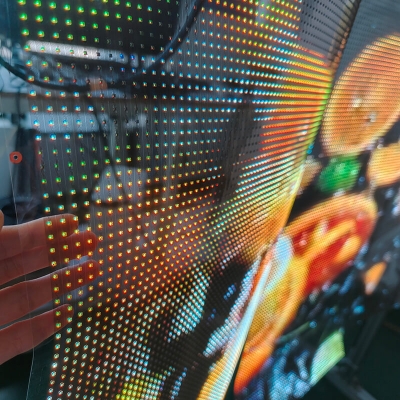
The StarLink Transparent LED Film Display features a brightness of up to 7000 nits and a two-in-one package design for LED chips and ICs.
Furthermore, traditional transparent
LED mesh screens typically require heavy steel frames, which increase wind loads and affect the safety of the building facade. In contrast, StarLink Transparent LED Film Display can be directly adhered to the glass surface. This significantly reduces structural stress and maintains the building’s original appearance.
For urban landmarks and commercial buildings, high brightness, high transparency, and minimal structural interference are fundamental considerations when choosing a Transparent LED Film Display.
Indoor Commercial Spaces Require Considerations for Resolution and Viewing Distance
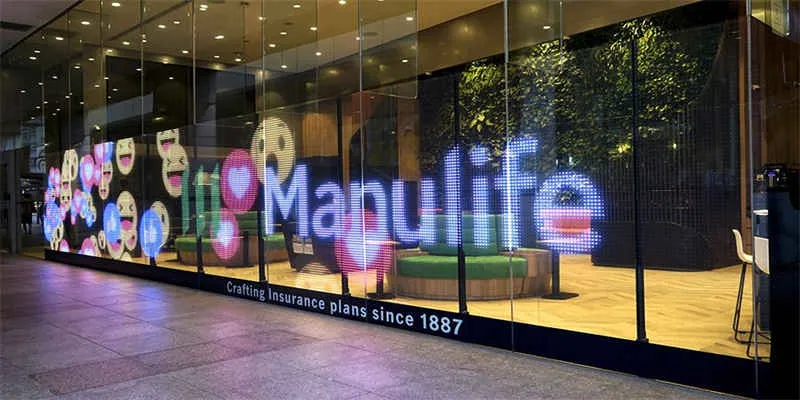
Indoor environments such as airports, exhibition centers, luxury atriums, and corporate lobbies require different optimization strategies. When selecting a transparent LED film display for indoor use, it’s crucial to consider viewing conditions at various distances, the surrounding lighting, and the required image clarity.
To address these conditions, StarLink Transparent LED Film Display’s P2.5 and P3.9 pixel pitch options provide sufficient pixel density for smooth text, detailed images, and high-definition video. The integrated LED and IC package ensures precise grayscale control, color consistency, and reduced failure rates at finer pitches.
Since indoor glass partitions typically have decorative and load-bearing limitations, lightweight film structures and frameless adhesive installation methods are critical. StarLink Transparent LED Film Display smoothly adheres to glass without drilling, preserving the glass’s integrity while harmonizing with the building’s interior design.
Furthermore, we offer custom poster sizes to ensure a perfect fit for display and indoor glass panels, escalator housings, or exhibition hall partitions.
How to Choose an Installation for Different Environments?
The environment determines whether direct glass bonding or frame-assisted installation is more suitable for the Transparent LED Film Display.
Our installation system offers two main options:
Direct bonding to the glass using a thin, flexible LED film. Alternatively, frame-assisted installation with custom components is suitable for non-standard glass surfaces.
For smooth, structurally stable glass surfaces, direct bonding is the optimal solution. It eliminates the need for steel structural supports, reducing weight, shortening installation time, and maintaining transparency.
For irregular surfaces, laminated safety glass, or locations requiring easy maintenance, the lightweight frame structure provides additional mechanical stability without compromising transparency.
Performance of Transparent LED Film Display Under Different Lighting Conditions
Lighting is one of the most critical environmental factors affecting the performance of transparent LED film displays. Poor brightness matching can lead to decreased contrast, blurred content, or excessive glare.
Choose different brightness levels to adapt to various lighting environments. For indoor atriums and shaded commercial spaces, choose 3000-4000 nits; for street-facing shop windows and outdoor glass curtain walls, select 5000-7000 nits.
However, this is not all. Integrated LED and IC packaging improves the signal stability and brightness uniformity of the entire film. Even on large, continuous glass surfaces, it ensures consistent image quality from edge to edge.
Transparent LED Film Displays: A Checklist Based on Your Specific Environment
To correctly select a transparent LED film display, the decision must always be based on the usage environment, not just the product manual. Based on JR Visual’s engineering experience and StarLink’s technological advantages in transparent LED film displays, here is a practical selection framework:
First, you need to determine the environment type: indoor or outdoor. Next, choose the viewing distance. For distances under 3 meters, we recommend P2.5 or P3.9; for 3-8 meters, P3.9 or P6.25 is suitable; and for distances over 8 meters, choose P6.25 or P10.
Then, you need to assess the ambient light intensity and the glass structure. For intense light, we recommend a display with a light intensity greater than 6,000 nits; 3,000-4,000 nits is optimal. Standard tempered glass can be directly glued on; otherwise, a frame is recommended for installation.
Following these steps will ensure your transparent LED film display becomes not just a digital screen, but an integral part of your building and brand ecosystem.