
Imagine yourself driving along a busy city highway at dusk, surrounded by an outdoor LED display of varying sizes and brightness vying for your attention—some advertisements clear, vivid, and impressive; others blurry and even glaring. This stark contrast underscores the importance of evaluating actual display quality before purchasing outdoor LED displays.
In today’s highly competitive outdoor advertising market, display quality directly determines the effectiveness of advertising content dissemination, the viewing experience for passersby, and ultimately, the buyer’s return on investment. Statistics show that high-quality outdoor LED billboards can increase viewer attention by 47% compared to billboards with poor display quality. For businesses and organizations looking to invest in outdoor visual communication tools, mastering methods for accurately evaluating the actual display quality of outdoor LED displays is not only a necessary step in the purchasing process but also crucial to maximizing the value of their advertising investment.
Brightness is fundamental to display quality, especially in outdoor environments where lighting conditions vary drastically with sunrise and sunset, sunny days, and cloudy or rainy days. A high-performance display not only boasts high peak brightness but also maintains uniform brightness distribution across the entire screen and flexibly adapts to changes in ambient light.
Brightness Uniformity and Adaptability to Ambient Light
To evaluate this aspect, the screen can be observed under different natural lighting conditions: at midday on a sunny day, the display should be bright enough to ensure clear visibility of content without glare; in the afternoon or at dusk on a cloudy day, it should automatically adjust its brightness to avoid the image being too dark or too bright. Uniformity can be checked by displaying a pure white image—any dark spots, bright spots, or unevenly lit areas directly impact the viewing experience.
Professional testing tools can measure brightness values. Qualified outdoor advertising LED screens typically have a peak brightness of 5000 nits or higher to withstand strong sunlight. However, brightness alone is not the only criterion; dynamically adjusting brightness based on ambient light intensity is equally important. This not only ensures a consistently clear display but also reduces energy consumption and extends screen lifespan.
Color Reproduction Accuracy of Outdoor LED Displays
Color is a key factor in attracting viewers’ attention and conveying the emotional meaning of displayed content. The color reproduction accuracy of an outdoor LED display shows its ability to reproduce original content colors without distortion.
To evaluate this, play high-definition images or videos with rich color gradations. Examples include landscapes, product photos, and promotional videos. Then, observe whether screen colors match the original content. Check if the sky is pure blue without green or purple hints. Verify that reds, such as brand logos, are vibrant and follow official standards. Ensure skin tones appear natural in human images.
Another key factor is color uniformity. The same color should remain consistent across all areas of the screen. Poor color reproduction makes content appear dull, distorted, or misleading. This significantly reduces the effectiveness of advertising and information. High-quality outdoor LED displays use advanced color calibration technology to cover a wide color gamut. This ensures accurate color across different lighting conditions. Moreover, observe the screen from different angles. Large viewing angles may cause color shifts that affect overall perception.
Clarity and Resolution Performance
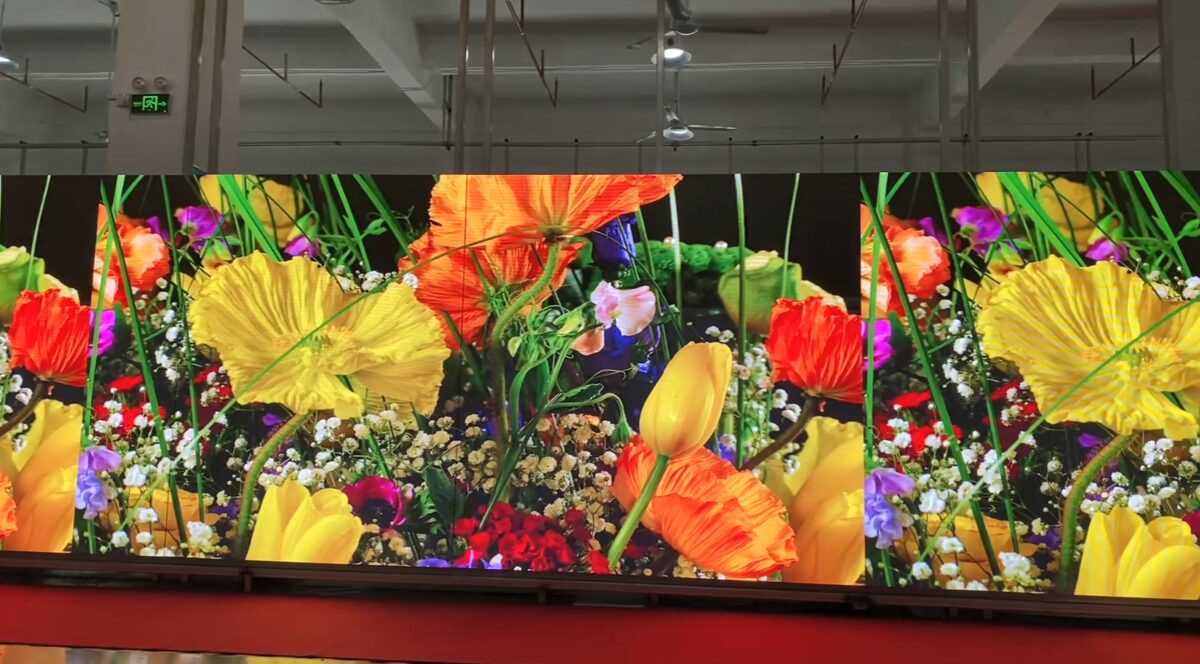
Clarity directly determines whether viewers can discern details in the displayed content. This indicator is closely related to the display screen’s resolution and the LED module’s dot pitch. Dot pitch refers to the distance between adjacent LED pixels; the smaller the dot pitch, the more pixels per unit area, resulting in higher resolution and a clearer display. When evaluating clarity, display text in different sizes (especially small fonts commonly used in advertising slogans or event notices) and check whether the text edges are sharp and clear, without blurring or jagged edges.
Secondly, playing high-definition videos, such as fast-moving scenes like sports events or animated advertisements, can also test clarity—observe whether the dynamic image is smooth, whether there is ghosting or blurring, and whether image details are preserved. Appropriate resolution and dot pitch depend on the viewing distance of the target audience.
Outdoor LED Display Screen Contrast Ratio
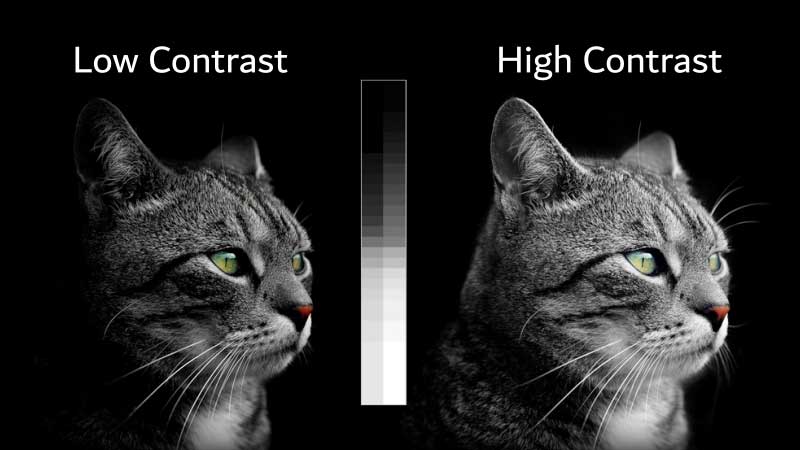
Contrast ratio is the ratio of a display’s maximum brightness (white) to its minimum brightness (black). High contrast ratio allows the screen to display richer levels of light and dark, making images more layered and realistic. In outdoor environments, strong ambient light can easily reduce a display’s contrast ratio, making dark areas appear grayish and details hard to see.
When evaluating contrast ratio, display images with significant contrast, such as night scenes, black-and-white photographs, or images with gradient shadows. Check whether the black areas on the screen are deep enough. Ensure dark details remain clearly visible. Observe if transitions between light and dark are natural and smooth. A display with poor contrast appears flat and uninteresting. Key content may fail to stand out.
Outdoor LED displays generally employ technologies such as high-grayscale driving and black-screen design to improve contrast ratios. Even under strong ambient light, they can maintain a high contrast ratio, ensuring the displayed content is clearly defined and visually impactful. Therefore, it is recommended to observe the display under both bright sunlight and dim lighting to evaluate contrast performance comprehensively.
Dynamic Display Stability of Outdoor LED Displays
Outdoor LED displays are commonly used to display dynamic content such as videos, animations, and scrolling text. Stuttering, ghosting, or flickering causes viewer discomfort and reduces display professionalism. To test dynamic stability, play fast-moving high-definition videos. Observe whether playback is smooth and if any frames are dropped. Test scrolling text at different speeds. Check that the text remains clear, continuous, and free from blurring or ghosting.
Flickering is another important indicator; although some flickering is invisible to the naked eye, prolonged viewing can cause eye fatigue. Professional tools can detect flicker frequency and amplitude, but simple observation methods can also be used—for example, taking a photo of the display with a mobile phone camera. If obvious stripes appear on the screen in the photo, it indicates a flickering problem.
Viewing Angle Performance
Outdoor LED displays are viewed from different angles—by pedestrians on sidewalks and by drivers in moving vehicles. Good viewing-angle performance ensures the display remains consistent across angles.
To evaluate viewing angles, stand at different positions around the display: front, left, right, above, aa nd below. Observe brightness, color, and sharpness from each angle. At 45 degrees, brightness should remain strong, colors should be stable, and text and images should be clearly legible. A high-quality outdoor advertising LED screen usually has a horizontal viewing angle of ≥160 degrees and a vertical angle of ≥140 degrees. Wide viewing angles ensure more viewers can see the content clearly. Poor viewing angles reduce effective range, lower audience reach, and weaken communication effectiveness.
Comprehensive Evaluation of the Outdoor LED Display’s Actual Display Effect
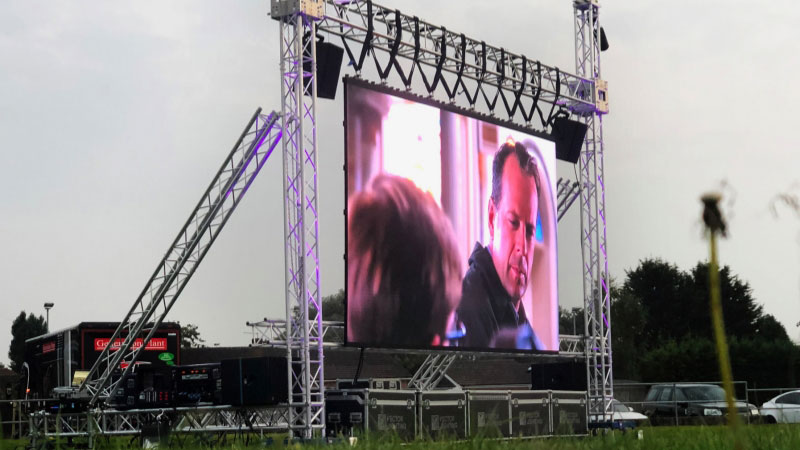
Evaluating outdoor LED displays requires a careful consideration of multiple dimensions, rather than relying on a single indicator. Brightness uniformity, color accuracy, sharpness, contrast, dynamic stability, and viewing angles all affect the viewing experience. A high-quality outdoor LED display should perform well across all aspects. It must adapt to complex outdoor conditions and convey content accurately to the audience. Using the evaluation methods analyzed in this article, purchasers can more accurately identify high-quality outdoor LED displays. Ultimately, the best display effect is clear, vivid, stable, and comfortable, capable of attracting viewers’ attention and effectively conveying information in any outdoor environment.