
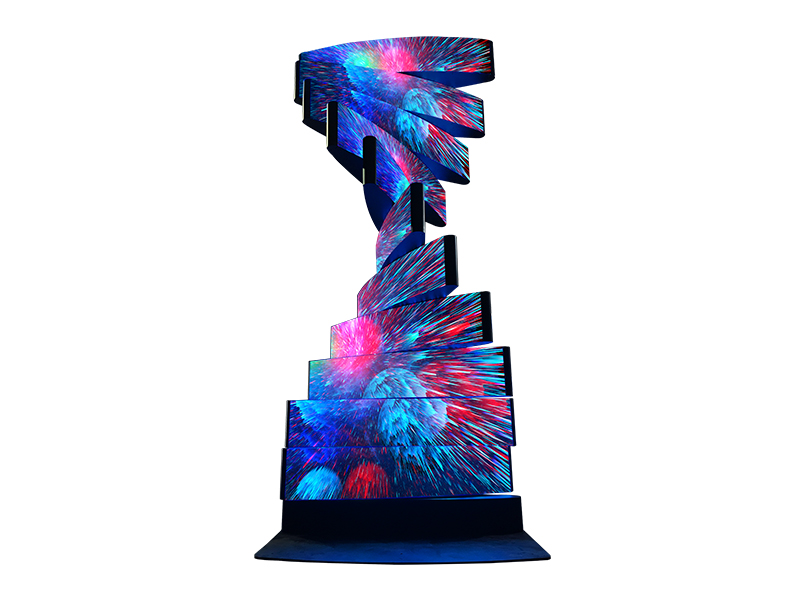
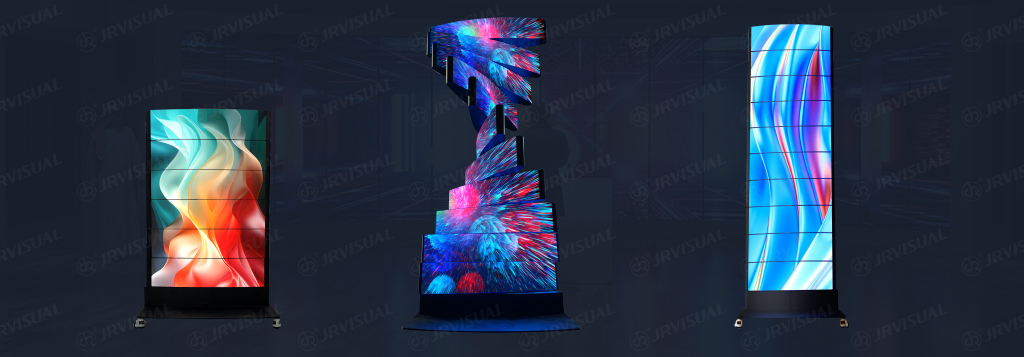
Choosing the right pixel pitch for a rotating LED screen is related to visual clarity, structural feasibility, and long-term reliability. Unlike static LED walls, rotating LED displays introduce complexities in motion dynamics, mechanical load variables, and signal transmission. Therefore, the pixel pitch selection must be evaluated at a broader system level. As a professional LED display manufacturer, JRVISUAL’s DNA rotating LED display series offers five pixel pitch options: 1.2mm, 1.5mm, 1.8mm, 1.9mm, and 2.0mm, with fully customizable diameter and height configurations. This rich selection of specifications allows for precise matching of resolution, viewing distance, and installation budget.
Pixel Pitch and Visual Performance of Rotating LED Screen
Pixel pitch is the physical distance between adjacent LED pixels and directly affects image resolution and viewing clarity. It is particularly important in rotating LED displays because the screen is constantly in motion, and viewers may view it from different angles and distances. If the pitch is too large, the motion amplifies pixel visibility; a smaller pitch ensures a smooth visual experience even during rotation.
Pixel Pitch Options for DNA Rotating LED Screen (1.2mm–2.0mm)
JRVISUAL’s rotating LED screens offer the following small-pitch configurations:
- P1.2mm – Ultra HD, ideal for superior viewing at close range (3-4 meters).
- P1.5mm – High-definition clarity for retail and corporate spaces (4-5 meters).
- P1.8mm – Balances resolution and cost-effectiveness (5-6 meters).
- P1.9mm – Optimized commercial-grade performance.
- P2.0mm – An economical option for medium-distance environments (6-8 meters).
Smaller pixel pitches significantly increase pixel density per square meter, resulting in sharper text, smoother gradients, and greater image realism. This is especially important for luxury retail stores, exhibition halls, and high-end brand environments, where customers may be standing several meters away viewing the screen. Conversely, choosing a slightly larger pitch, such as P1.9 or P2.0, reduces the number of LED modules required for the same physical size. This reduces hardware investment and control bandwidth requirements while maintaining good visual performance at moderate viewing distances.
Viewing Distance and Application Matching
A common rule in the LED industry is: Optimal viewing distance ≈ Pixel pitch (mm) × 2.5–3.5
While this rule provides a useful benchmark, practical decisions must also consider lighting conditions, content complexity, and audience movement patterns. For example, a rotating LED screen installed in a dimly lit museum space can utilize a higher pixel pitch to maximize image detail. In contrast, a brightly lit atrium may rely more on brightness and contrast than ultra-high pixel density. In rotating LED screens, a smaller pixel pitch also reduces the visibility of dividing lines between modules. Any slight misalignment becomes more noticeable as the screen rotates. Therefore, a smaller pixel pitch generally creates a more harmonious cylindrical visual effect.
Structural Design, Control Systems, and Customization of Rotating LED Screen
A rotating LED display is an integrated system that combines display electronics, structural engineering, motorized rotating components, and intelligent signal transmission. Pixel pitch not only affects image quality but also mechanical load distribution, heat dissipation management, and power planning. JRVISUAL’s DNA rotating LED screen features a precision-balanced rotating core. Each cabinet module is mounted on a reinforced frame that evenly distributes weight around the rotation axis. When smaller pitches (e.g., P1.2mm or P1.5mm) are chosen, the number of modules per square meter increases significantly. This increases the screen’s overall weight and rotational inertia.
To compensate for this, JRVISUAL integrates high-torque motors, a dynamic balancing system, and industrial-grade bearings to ensure smooth acceleration and deceleration. Furthermore, vibration-damping components are incorporated to prevent micro-jitter that could affect image stability. Structural reinforcement is particularly important for larger-diameter rotating LED displays, especially during continuous rotation.
For medium-pitch modules (e.g., P1.8mm–P2.0mm), reducing module density decreases mechanical stress. These configurations are generally more suitable for large installations with simpler structures and higher long-term durability requirements.
Control System and Signal Stability
High-resolution rotating LED displays require powerful signal processing capabilities and stable data transmission. Fine-pitch screens have significantly higher pixel counts, thus placing higher bandwidth demands on LED controllers and media servers. Fine-pitch rotating LED screens are commonly used in broadcast and live-streaming environments. In such cases, controller selection must also consider camera shutter synchronization to avoid scan lines. Therefore, controller architecture and pixel pitch must be evaluated simultaneously during the project planning phase.
Flexible Size Customization
A major advantage of the JRVISUAL DNA rotating LED display portfolio is its flexible customization capabilities. We are not limited to standard sizes but offer adjustable diameters, different heights, and tailor-made structural solutions. Whether the application is a compact rotating LED light column in a boutique window or a large suspended cylindrical display in an exhibition center, our engineering team will configure the module arrangement accordingly. The choice of pixel pitch directly affects cabinet layout and curvature tolerances. Fine-pitch modules allow for smaller radii of curvature, while slightly larger pitches simplify assembly for large-diameter installations.
Application Scenarios of Rotating LED Displays
When selecting the appropriate rotating LED screen, long-term value creation should always be considered. Beyond technical specifications, the ultimate goal is to maximize audience engagement, brand exposure, and operational efficiency.
Retail and Luxury Showrooms
In luxury retail environments, visual precision directly impacts brand perception. P1.2mm and P1.5mm rotating LED displays deliver ultra-clear images, enhancing product presentation and immersive storytelling experiences. High-resolution displays extend customer dwell time and increase social media engagement, resulting in measurable marketing results. Furthermore, fine-pitch rotating LED screens can present clear close-up video content, enhancing customer engagement. Retailers typically experience increased foot traffic and brand awareness after deploying dynamic rotating LED installations.
Corporate, Exhibition, and Public Spaces
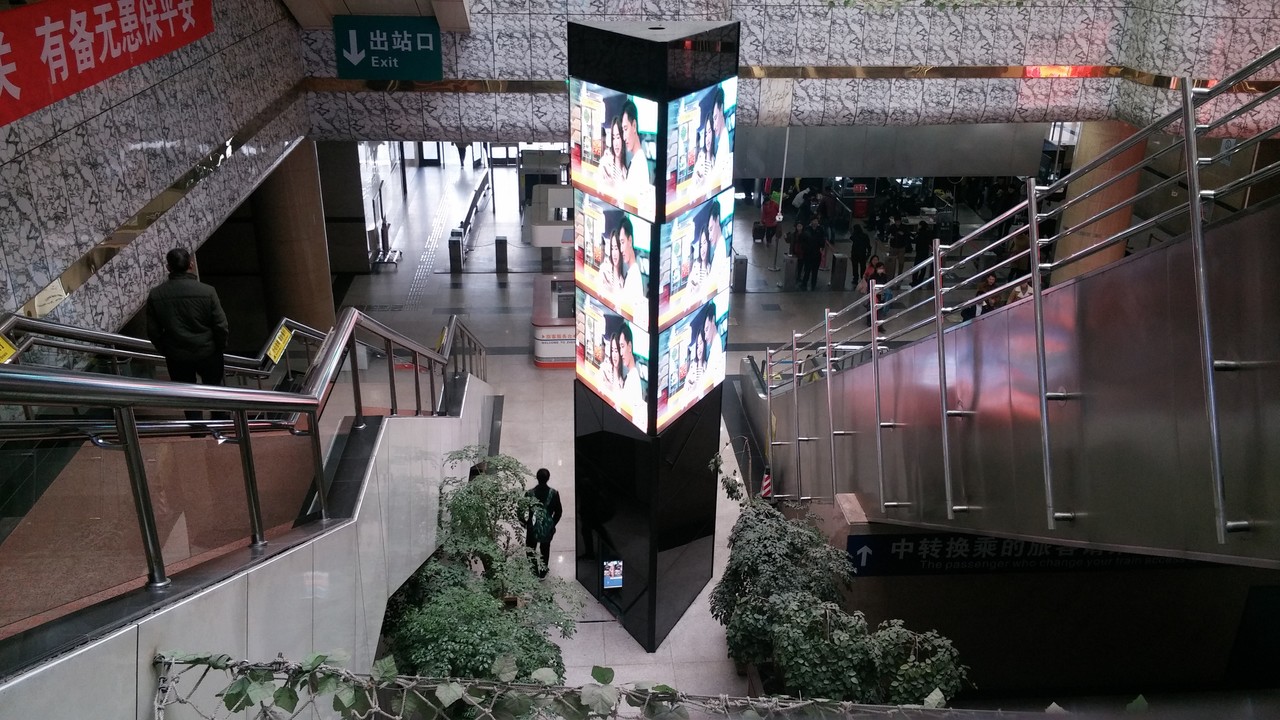
For venues such as corporate lobbies, airports, and exhibition halls, P1.8mm to P2.0mm specifications offer a strong visual impact at an optimized cost structure. These environments prioritize prominent brand identity, wayfinding signage, and environmental digital art over intricate micro-details. Rotating LED displays in public spaces serve as both information platforms and visual focal points for architecture. Maintaining both high resolution and structural simplicity ensures sustainable operation and predictable maintenance costs.
Flexible Pixel Pitch Options
JRVISUAL’s DNA rotating LED screen series offers flexible pixel pitch options, including 1.2mm, 1.5mm, 1.8mm, 1.9mm, and 2.0mm, and can be customized in size and shape to meet architectural and creative needs. By combining precise viewing-distance guidance, mechanical planning, and content previsualization, you can ensure your rotating installation is not only eye-catching but also delivers lasting visual and commercial value. If needed, we can tailor specification sheets and space models to help you visualize the effect of each pixel pitch in actual dimensions.