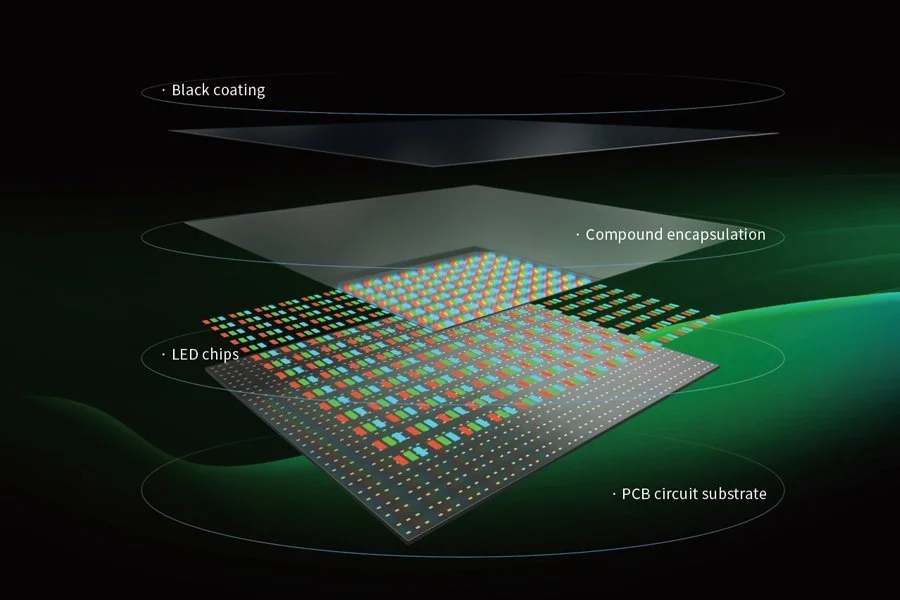
COB LED display technology offers unmatched brightness, uniformity, and reliability. In short, it integrates multiple LED chips directly onto a single substrate, forming a dense, high-intensity light source. This chip-on-board construction reduces the number of solder joints and simplifies the circuitry, effectively minimizing potential points of failure while enhancing overall durability. By encapsulating the chips with a silicone layer containing phosphor, the COB design efficiently converts blue LED light into uniform white light, producing vibrant, consistent illumination.
The combination of dense chip placement, reduced electrical parasitics, and efficient heat dissipation ensures smooth, homogeneous visuals, high brightness, and consistent color reproduction across large surfaces. With these capabilities,
COB LED displays elevate image quality and visual impact.
Working Principle of a COB LED Display
A COB LED display functions by directly mounting an array of LED chips onto a single substrate or printed circuit board. Unlike SMD LEDs, which place individual chips on separate packages and then attach them to a PCB, COB LEDs integrate all the diodes into one cohesive module. Electrical connections are simplified to just two contacts regardless of the number of chips, reducing the resistance and potential points of failure.
The substrate serves both as a mechanical support and a heat conductor. When current passes through the COB LED, electrons recombine with holes in the semiconductor, emitting photons in the visible spectrum. The dense packaging allows multiple chips to operate together, producing a single, high-intensity light output. Chip orientation—such as front-mounted, flip-chip, or semi-flip-chip—affects light emission angle and thermal behavior, enabling the screen to achieve larger viewing angles, higher brightness, and smoother color reproduction compared with conventional LED arrangements.
Thermal Management and Reliability
Thermal performance is a critical factor in maintaining the lifespan and stability of a COB LED display. The integrated substrate design lowers thermal resistance, allowing heat generated by the densely packed chips to dissipate efficiently. Reduced heat accumulation prevents temperature spikes that can accelerate LED degradation or cause color shifts.
High-current operation in COB LEDs generates less overall heat than in SMD configurations, resulting in lower panel temperatures and improved reliability. The robust thermal management ensures consistent luminance across the screen, even during extended operation, and reduces the failure rate of individual diodes. This stability makes chip-on-board LED displays particularly suitable for demanding applications.
Optical Performance and Viewing Experience
The optical characteristics of a COB LED display set it apart from traditional SMD screens. By integrating ultra-fine LED chips with minimal spacing,
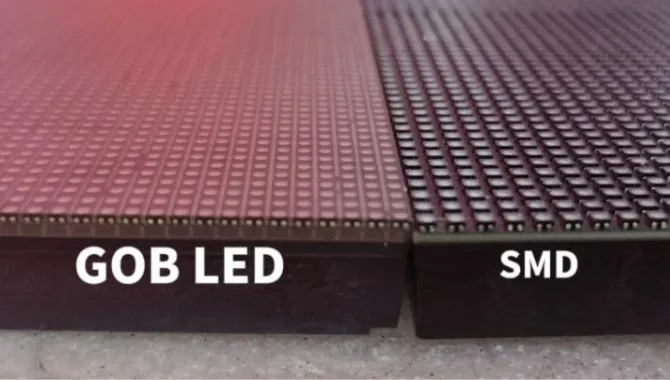
COB technology achieves near-total coverage of the PCB surface, often reaching 99% black occupancy. This dense configuration enhances contrast, delivers uniform light distribution, and minimizes the visible gaps between pixels.
Light beams emitted from flip-chip-on-board LEDs naturally diverge, providing a wider viewing angle without the need for additional optical components. The result is a high-brightness screen with uniform color saturation and smooth gradients. This reduces the “screen door” effect often seen in SMD LED panels. COB LEDs feature an anti-collision resin coating that protects against dust, moisture, and oxidation. This coating preserves image clarity and ensures consistent visual quality over time.
Advantages of a COB LED Display Over SMD Screens
COB LED displays offer several advantages over traditional SMD screens, including improved performance and greater manufacturing efficiency. Integrated packaging produces high-intensity, homogeneous light with minimal refraction loss, enhancing brightness and clarity. The wider light-emitting area improves viewing angles, enabling audiences to experience consistent visuals even from extreme viewing angles.
The compact design of COB modules reduces the space required for wiring and assembly, streamlining production and lowering labor costs.
Protective resin coatings safeguard the LEDs against static, moisture, and mechanical shocks, further improving durability. Additionally, lower thermal resistance and more efficient heat dissipation enable COB screens to operate at high current levels with minimal performance loss, resulting in reliable long-term operation and reduced maintenance.
COB LED Display Applications and Flexibility
COB LED displays are versatile across indoor and outdoor applications. In high-resolution indoor environments, they deliver exceptionally smooth images at fine pixel pitches below PH0—Xmm. This makes them ideal for control rooms, studios, and retail displays. Outdoor applications benefit from high brightness and wide viewing angles. They also resist environmental factors such as dust, moisture, and temperature fluctuations.
The flexible nature of COB modules also allows for creative screen designs, including curved and irregular surfaces. Their compact design makes them easy to integrate into rental screens, transparent displays, or fine-pitch video walls. They provide uniform brightness and seamless image continuity. COB LED displays combine excellent visual performance, thermal stability, and mechanical protection. This combination allows them to meet demanding commercial and entertainment requirements.

Why COB LED Display Defines the Future of LED Screens
The chip-on-board LED display represents a culmination of advanced semiconductor engineering and intelligent design. By integrating multiple LED chips onto a single substrate, COB technology achieves superior thermal management, high-intensity luminance, wide viewing angles, and remarkable visual uniformity. These characteristics address the limitations of conventional SMD LED panels and set the standard for next-generation high-resolution displays.
COB LED displays also simplify assembly, reduce production costs, and enhance durability and long-term reliability. Their fine-pitch capability supports the development of Micro LED screens, positioning COB technology as a critical step toward the future of ultra-high-definition, energy-efficient LED displays.