
Most LED screen orders are straightforward. You pick a size, confirm a pixel pitch, and wait for delivery. A custom rotating LED screen is a different conversation entirely — and buyers who treat it like a standard order almost always run into problems. The rotating mechanism, the structural form, the motion scripting and the weight load on the base — each of these variables intersects with the others. Getting one wrong delays everything. So this article breaks down exactly what JR Visual’s custom rotating LED screen build process looks like, what you can configure, and what realistically drives lead times.
What Makes a Custom Rotating LED Screen Different
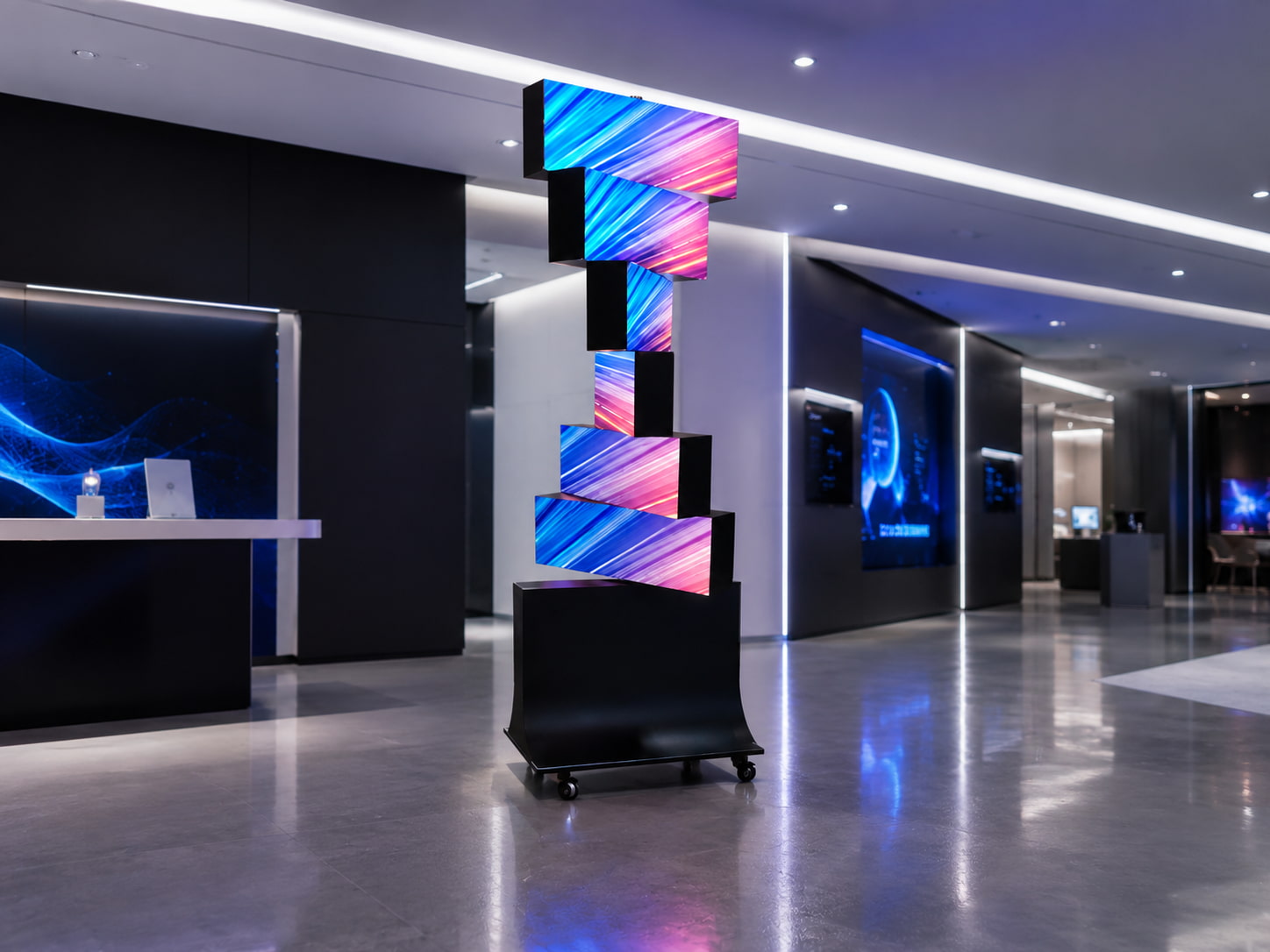
A standard flat LED panel ships in modular tiles. A custom rotating LED screen ships as a configured system — display panels, mechanical base, control hardware, and motion firmware working together as one unit. JR Visual’s DNA rotating LED screen, for example, supports 360° unlimited rotation and operates 24/7. That operational standard shapes every component choice: the structural frame, the motor assembly, the CAT 6 signal transmission path, and the power input at AC 110–240V, 50/60Hz. None of these are off-the-shelf decisions. Each one gets spec’d to your configuration at the factory before anything ships. That’s why a custom rotating LED screen isn’t just a product order — it’s closer to a manufacturing brief.
Build Configurations for the Custom Rotating LED Screen
JR Visual’s Kinetic LED Display lineup supports three primary build paths, each with its own structural logic. The right configuration depends on your viewing angles, available floor space, and content requirements. As a result, getting this decision right before production starts is what keeps the project on schedule.
Screen Models and Pixel Pitch Options
JR Visual currently offers three rotating screen models: double-sided flat, double-sided curved, and triangular rotating. Each serves a different visual purpose. The double-sided flat model maximizes content clarity from two opposing angles. The curved variant wraps the display surface for a softer, more immersive visual arc. The triangular form creates a three-face rotating unit suited to high-traffic 360° viewing environments. Pixel pitch runs from P1.2mm through P2mm, covering P1.2, P1.5, P1.8, P1.875, P1.953, and P2. For close-viewing installations where audiences stand within 2–4 meters, P1.5mm or P1.875mm is the standard choice. Larger venues or installations viewed from 5 meters and beyond can move to P2mm without visible resolution loss.
Dimensions and Layer Customization
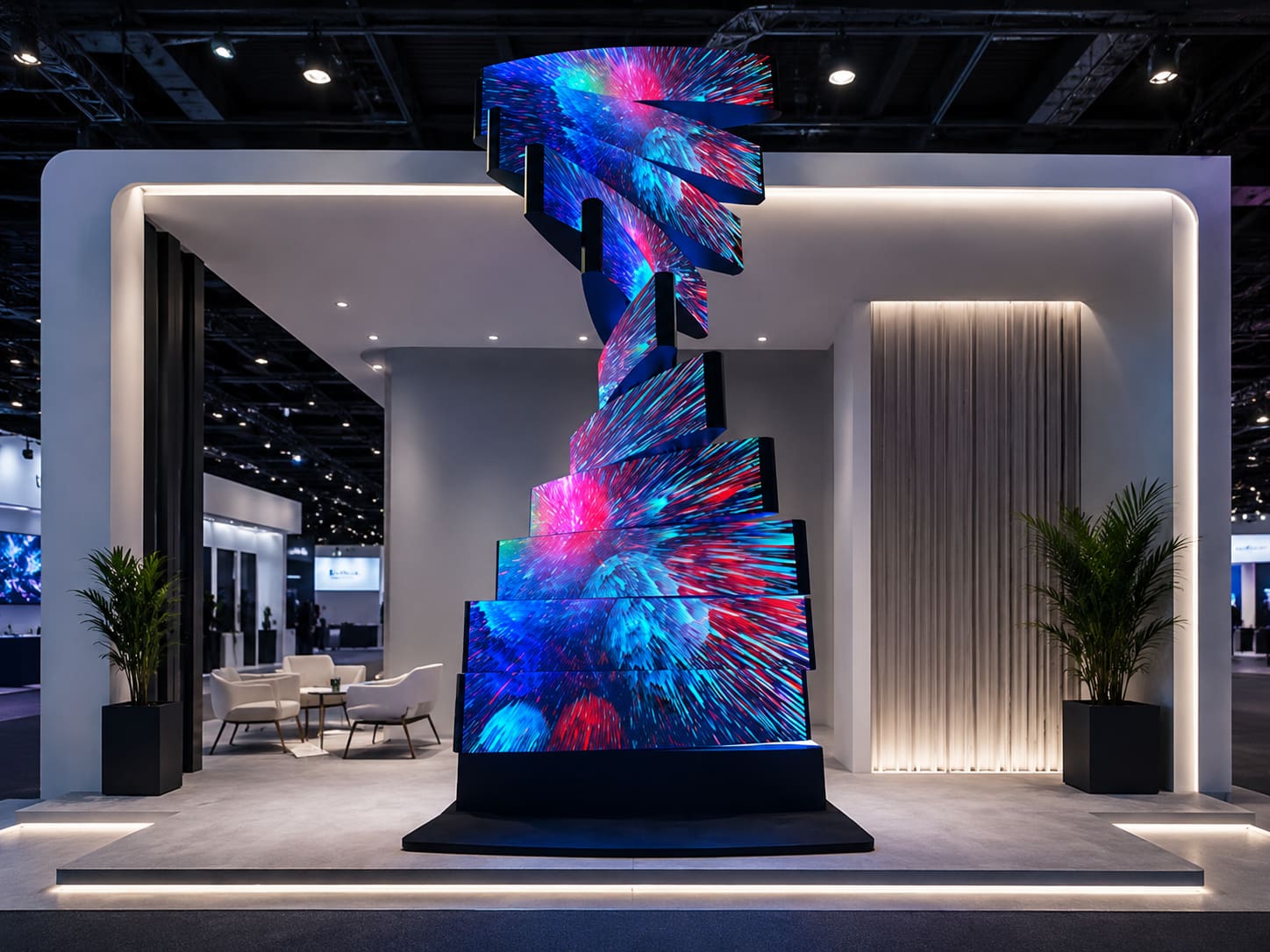
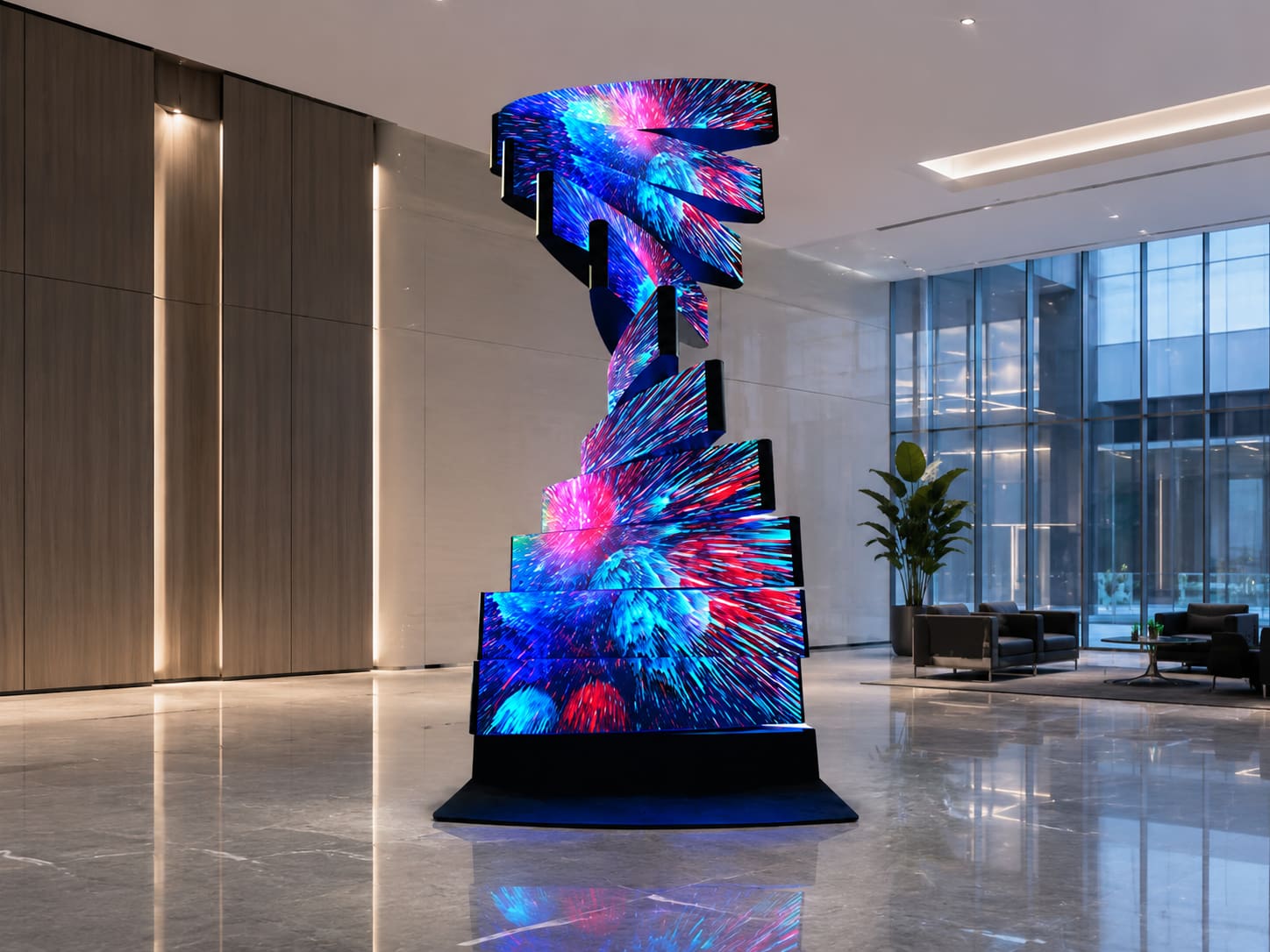
Layer count is configurable. The double-sided curved model ships in 6-layer or 10-layer configurations as standard, with custom layer counts available on request. Each layer uses a 320 × 160mm flexible LED module, and the factory sets the gap between layers at 2mm for visual consistency.
A 6-layer curved unit measures 1,280 × 1,920mm (W × H) with a display resolution of 640 × 960 pixels per side. The 10-layer version scales to 1,280 × 3,200mm at 640 × 1,600 pixels per side. Net weight for the 6-layer unit runs approximately 258kg for the display panel plus 200kg for the base — structural load planning is non-negotiable at this scale. Multiple units can also be spliced and run simultaneously, which makes the rotating LED screen viable for large-format multi-unit installations.
Motion Control and Script Options
The motion system runs on built-in, user-editable scripts, with software-adjustable parameters for rotation speed and opening/closing speed. Control operates via TCP/IP protocol over a network-based system. Each motion script supports one bound video file, and multi-script support allows multiple videos mapped to multiple motion sequences.
In addition, the system supports external UDP-based invocation for integration with third-party show control software — relevant for touring productions or live event environments where cue-based triggering is standard. Self-recovery functionality is built in: the software detects and automatically clears errors, which matters for 24/7 deployments where manual intervention isn’t always available.
How the Custom Rotating LED Screen Is Installed
JR Visual ships the display panel and mechanical base as separate units. On-site, the crew stands the panel upright and fastens it to the base with screws. Signal transmission runs over CAT 6 cabling. Weight load planning is non-negotiable at this scale. The 10-layer curved unit ships at a gross weight of 614kg for the display panel and 319kg for the base — a combined 933kg before any rigging or floor load factors. Site surveys and structural sign-off belong in the pre-order conversation, not the installation week.
Power draw is equally worth planning around: 4.5 kW maximum for the 6-layer curved unit, 7.5 kW for the 10-layer unit. Double-sided flat units run up to 3.5KW. These figures determine the electrical circuit requirements at the installation location.
What Affects Lead Times on a Custom Rotating LED Screen
Three factors drive lead time on any custom rotating LED screen order: configuration complexity, layer count, and whether the unit requires factory testing before shipment. Standard configurations — such as the double-sided flat at P1.875mm or P1.953mm with a fixed layer count — move faster because the component sourcing path is already established. However, custom layer counts, non-standard dimensions, or spliced multi-unit builds extend the production window because each requires individual engineering review.
Factory testing adds time but removes risk. JR Visual runs full motion sequence tests on assembled units before dispatch, which is the right call for any installation where downtime carries a cost. Buyers who skip pre-shipment testing to accelerate delivery often absorb that time — and more — during installation. Realistic lead time conversations should happen at the inquiry stage, not after the purchase order is placed. JR Visual’s standard lead time is 15 to 25 working days, depending on order quantity and customization level, and the confirmed timeline is locked in before order confirmation.
FAQ
Can the rotating LED screen run continuously without shutting down?
Yes. The DNA rotating LED screen supports 24/7 continuous operation. The built-in self-recovery functionality detects and automatically clears errors, so the system doesn’t require manual intervention during extended deployments.
What is the minimum pixel pitch available for a custom rotating LED screen?
The smallest available pixel pitch is P1.2mm, suited to close-viewing environments where audiences stand within 2 meters of the screen. For most commercial installations with a viewing distance of 3–5 meters, P1.5mm or P1.875mm is the more practical choice.
Can multiple rotating LED screen units run simultaneously?
Yes. Multiple units can be spliced and controlled simultaneously over a TCP/IP network. Each unit can run its own motion script and video file, or units can be synchronized for a unified multi-screen display.
How much floor load capacity is required for installation?
The 10-layer curved unit has a combined gross weight of approximately 933kg across the display panel and base. Floor load ratings and structural clearance need to be confirmed before the unit arrives on site — this is a standard part of the pre-order consultation process.
Does the motion speed affect the LED display image quality?
No. The motion script system controls rotation speed and opening/closing speed independently from the display signal. Image quality — resolution, refresh rate and brightness — remains consistent regardless of the selected motion configuration.
Get Your Custom Rotating LED Screen Spec’d Right the First Time
The decisions that most affect a custom rotating LED screen project — screen model, pixel pitch, layer count, power requirements, installation load — all happen before production begins. Changing them mid-build is expensive and slow. That’s why JR Visual’s technical team handles pre-order spec consultations as standard. If you’re at the early planning stage, the most useful step is to submit an inquiry with your viewing distance, available floor space, and power infrastructure — the team can work backward from those constraints to a configuration that actually fits your project.