
Most event displays do one thing well: face the audience. LED spheres do something fundamentally different — they face everyone, all at once. That 360-degree visibility changes how a venue feels, how long guests linger, and how far your event content travels on social media. But renting a spherical LED screen is not the same as booking a standard flat-panel. There are real variables that determine whether the result is stunning or underwhelming, and knowing them before you talk to a supplier saves both time and money.
What Types of Events Are LED Spheres Best Suited For
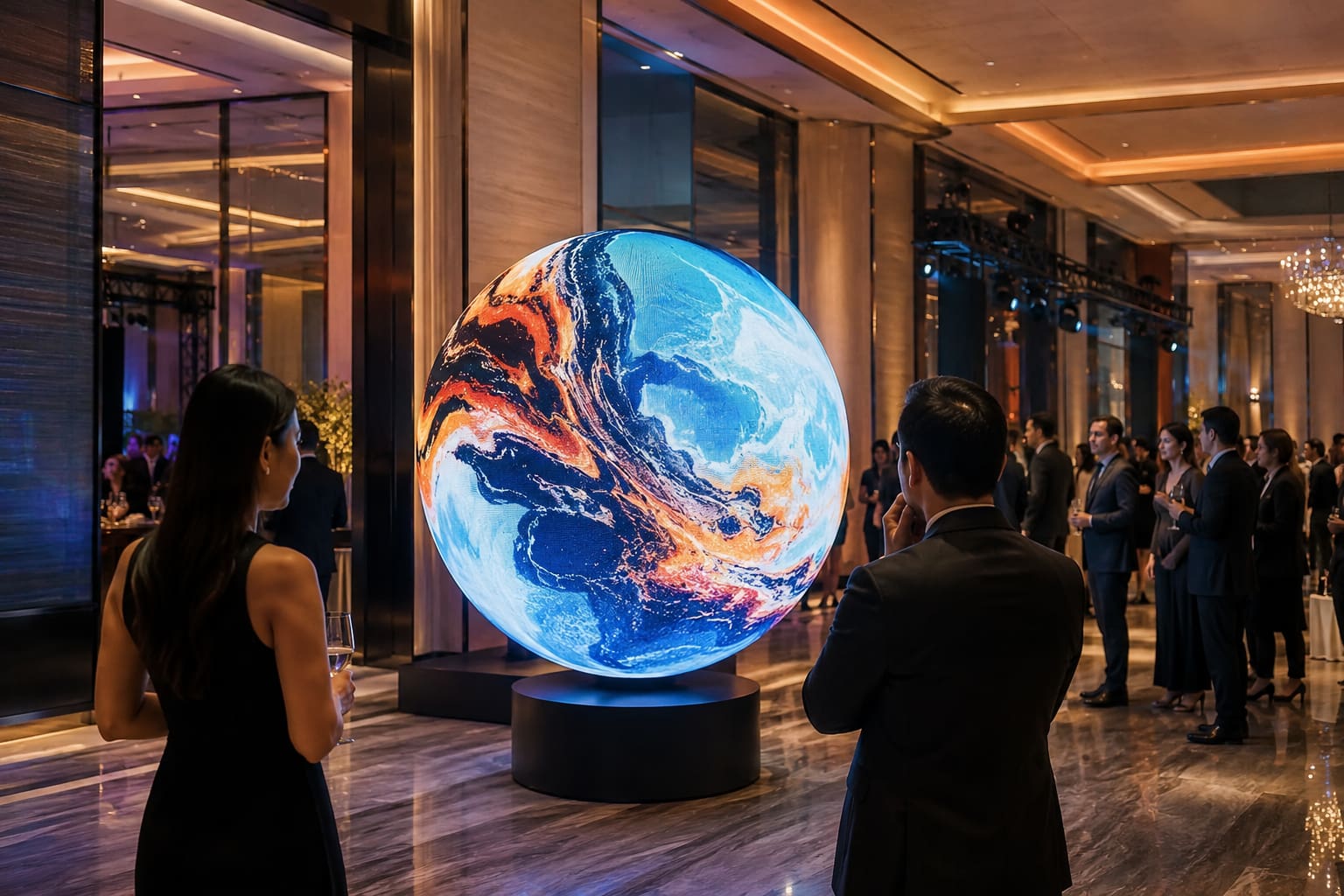
LED spheres work best when the audience is distributed — not seated in rows facing a stage, but moving around a space. Exhibition booths, corporate galas, brand activations, and product launches all share this characteristic: guests arrive from different directions, linger at different distances, and leave at different times. A flat screen serves one sightline. A sphere serves all of them simultaneously. That omnidirectional visibility does something a conventional display cannot — it eliminates dead zones. No matter where a guest stands in the room, the content is readable and the visual impact is consistent. In high-footfall environments where first impressions happen in seconds, that difference in coverage translates directly into engagement.
Real-world deployments bear this out. At Gitex 2023, a spherical LED display at the Etisalat booth drew consistent attention from the crowd across the show floor — not because of its content alone, but because visitors approaching from any angle could engage with it immediately. The booth became a landmark in the venue rather than just another display stand. For large-scale institutional events, the results are equally compelling. At the 50th Anniversary of IsDB in Saudi Arabia, a 3m diameter P2mm LED sphere served as the visual centerpiece at Kingdom Tower in Riyadh — a setting where visual impact and brand prestige needed to match the scale of the occasion. A traditional flat screen would not have delivered the same presence in that environment.
The common thread across these use cases is not the industry or the budget — it’s the audience flow. Wherever guests move freely through a space, led spheres consistently outperform conventional display formats.
How to Choose the Right LED Spheres for Your Event
Choosing the right spherical LED display comes down to three decisions: size, pixel pitch, and protection level. Get these right and everything else falls into place. But before diving into the technical specs, it helps to understand what drives each decision — because the wrong starting point leads to the wrong product, regardless of budget.
Size affects where the sphere can physically go and how much structural support it needs. Pixel pitch determines how sharp the content looks at your expected viewing distance. Protection level — specifically, GOB module treatment — determines whether the unit withstands repeated rental use or begins to show wear after the first few events. These three variables interact, which is why choosing one in isolation rarely works. A large-diameter sphere with the wrong pixel pitch for your venue’s depth will underdeliver visually. A high-resolution indoor unit without GOB protection will cost more in maintenance than the rental savings justify.
The good news is that once you know your venue type, viewing distance, and how frequently the sphere will be used, the right configuration becomes straightforward. The sections below break it down by environment.
Key Considerations for Indoor LED Spheres
For indoor events, pixel pitch is the priority. Indoor LED spheres in the P1.2mm to P2.5mm range work well for viewing distances of 2 to 5 meters, which covers most ballrooms, exhibition halls, and atrium spaces. Diameter typically ranges from 0.5m up to 3m, depending on venue scale. For rental use, GOB module protection is essential — it seals the LED surface against the wear that comes with repeated installation and teardown, and without it, degradation happens faster than most buyers anticipate.
Key Considerations for Outdoor LED Spheres
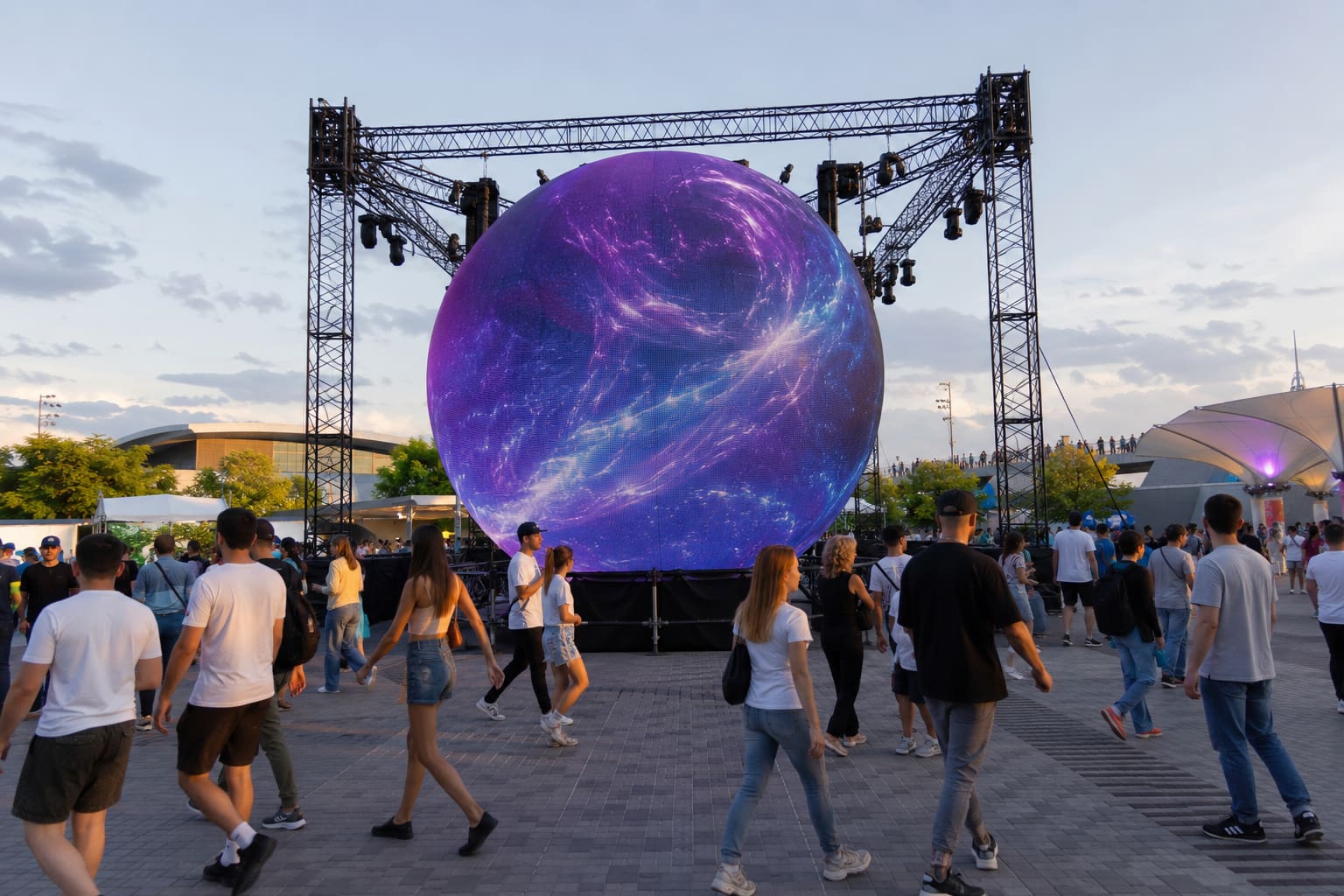
Outdoor sphere led screens operate under fundamentally different demands. P4mm or P5mm pixel pitch handles longer viewing distances while supporting the higher brightness needed to compete with ambient daylight. Diameter options generally start at 3m for outdoor settings. Weather resistance and structural load-bearing both need assessment before installation — IP-rated weatherproofing standards are the benchmark to confirm with your supplier before signing.
FAQ
Can LED spheres be customized in size?
Yes. Most professional suppliers offer a range of standard diameters — commonly 0.5m, 1m, 1.5m, 2m, 2.5m, and 3m — with larger custom sizes available for specific projects. Always confirm lead time for non-standard sizes before committing to an event date.
What kind of content works on a sphere LED screen?
Standard video content requires remapping to fit a spherical surface correctly. Your supplier should provide content specifications or a compatible media player that handles this automatically. Budget time for content preparation — last-minute files rarely display correctly without testing.
How long does installation take?
A 1m to 2m indoor LED sphere typically takes 2 to 4 hours for a professional crew to install and test. Larger outdoor units or suspended configurations require more time and advance structural assessment. Always build a buffer into your event-day schedule.
Is one sphere enough, or should I use multiple units?
For large venues, a single sphere acts as a focal anchor. Multiple units work well along a path or distributed across a space to create a consistent visual experience throughout. The right answer depends on your venue layout and budget.
What should I confirm with my supplier before signing?
Verify GOB module protection for rental units, content-format compatibility, rigging capacity for hanging, and on-site technical support availability. A reliable supplier should provide a clear spec sheet and a point of contact for day-of issues.
Start Planning Your Event with the Right LED Spheres
The difference between a display that stops people and one they walk past often comes down to the decisions made before the event date — not during it. Choosing the right LED spheres for your venue size, audience flow, and content type determines that outcome. Get the spec right from the start, and the display does the rest.