
Yes, and a flexible LED display screen is the reason. Airports don’t have flat walls. Terminals, departure halls, and retail concourses are full of curved surfaces, round columns, and angled architectural features. A standard rigid LED panel can’t follow those contours. However, a flexible LED display screen can. That single capability changes what’s possible for airport visual communication — from wayfinding and advertising to brand activations and passenger experience.
What Is a Flexible LED Display Screen?
A flexible LED display screen is built differently from the ground up. Instead of rigid aluminum cabinets, the display modules use a soft rubber casing. That rubber backing allows each module to bend, curve, and wrap around surfaces that would stop a conventional screen in its tracks.
The LED components sit inside the rubber module at precise intervals. They maintain consistent pixel density even when the screen curves. Strong magnets hold modules together during installation — the screen snaps into position cleanly, with no gaps and no misalignment.
The cabinet follows the module dimensions rather than locking into a standard size. As a result, manufacturers can build a flexible display into almost any shape: a full column wrap, a concave wall, a wave-form ceiling installation, or an irregular architectural feature. That adaptability sets it apart from every rigid alternative.
Why a Flexible LED Display Screen Suits Airport Environments?
Airports place demands on display technology that most other venues don’t. The architecture is complex, the audience is always moving, and the content needs to register instantly. A flexible LED display screen addresses each of those pressures directly.
It Conforms to Complex Airport Architecture
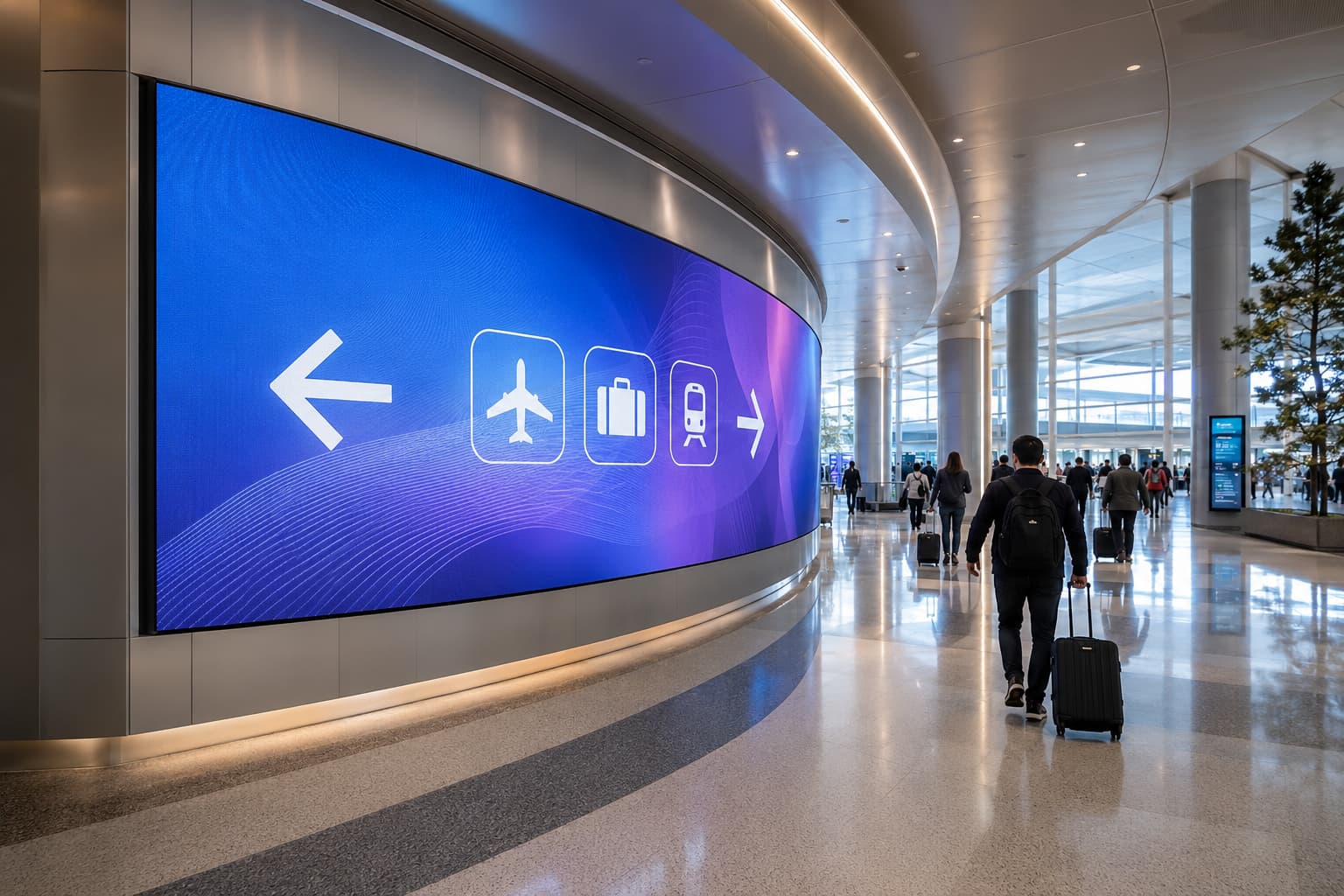
Most airport interiors weren’t designed with flat display surfaces in mind. Structural columns, curved check-in counters, rounded terminal walls, and arched ceilings are standard features — and they’re exactly where rigid LED panels fail.
A flexible LED screen wraps around cylindrical columns with a minimum bending diameter as tight as 306mm, depending on pixel pitch. It follows the natural curve of a wall — concave or convex — without leaving visible seams or gaps. In practice, this turns surfaces that rigid screens can’t access into usable, highly visible signage space.
That flexibility also cuts costs. Instead of retrofitting the architecture to accommodate flat panels, airports use the surfaces they already have. Fewer structural modifications mean faster installation and cleaner visual results.
It Maximizes Visual Impact for High-Traffic Spaces
Passengers move through airports quickly and from many directions. A display that looks sharp from one fixed angle loses its value the moment someone approaches from the side. For that reason, flexible LED screens deliver a horizontal viewing angle of 120° to 160° depending on the module. The image is clearly readable from nearly any angle.
Refresh rates at or above 3,840Hz eliminate flickering entirely — even when passengers photograph departure boards or retail signage on their phones. Beyond that, a contrast ratio of up to 10,000:1 keeps content sharp and vivid in brightly lit concourses.
Pixel pitches starting from 0.9mm allow detailed visuals at close range. Therefore, wayfinding screens and retail displays just one to two meters away still render crisp text and accurate brand imagery. That level of clarity is hard to match with conventional rigid panels.
Where Flexible LED Display Screens Shine — Real Airport Applications?
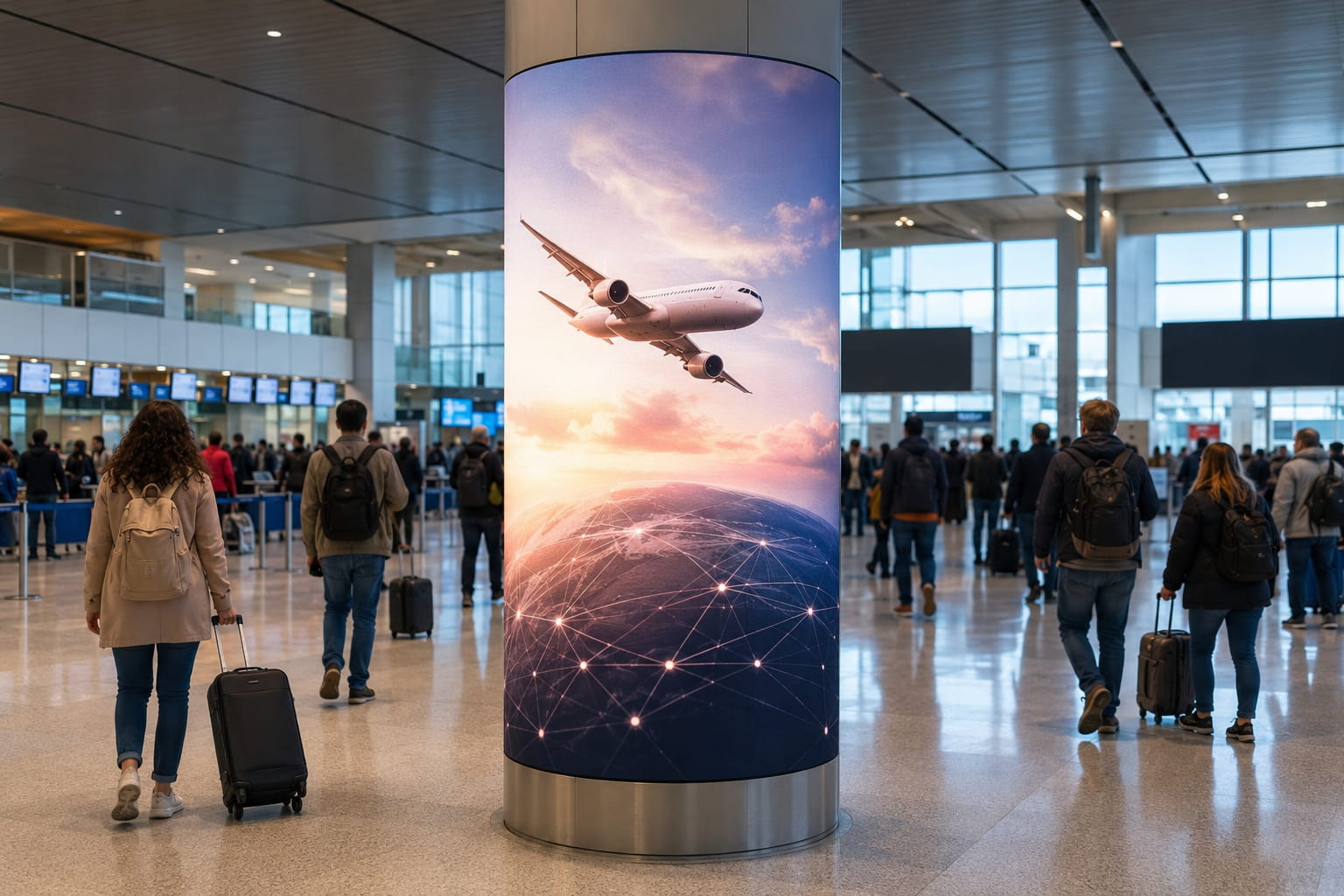
Flexible LED display screens work across the full range of airport spaces — and each environment brings a different set of demands. In departure terminals, column-wrap installations are among the most common applications. Structural columns sit at natural passenger flow points — exactly where high-visibility signage belongs. A flexible LED screen wraps the entire column surface, turning dead architectural space into a 360-degree display. Passengers approaching from any direction see the content clearly, without dead angles.
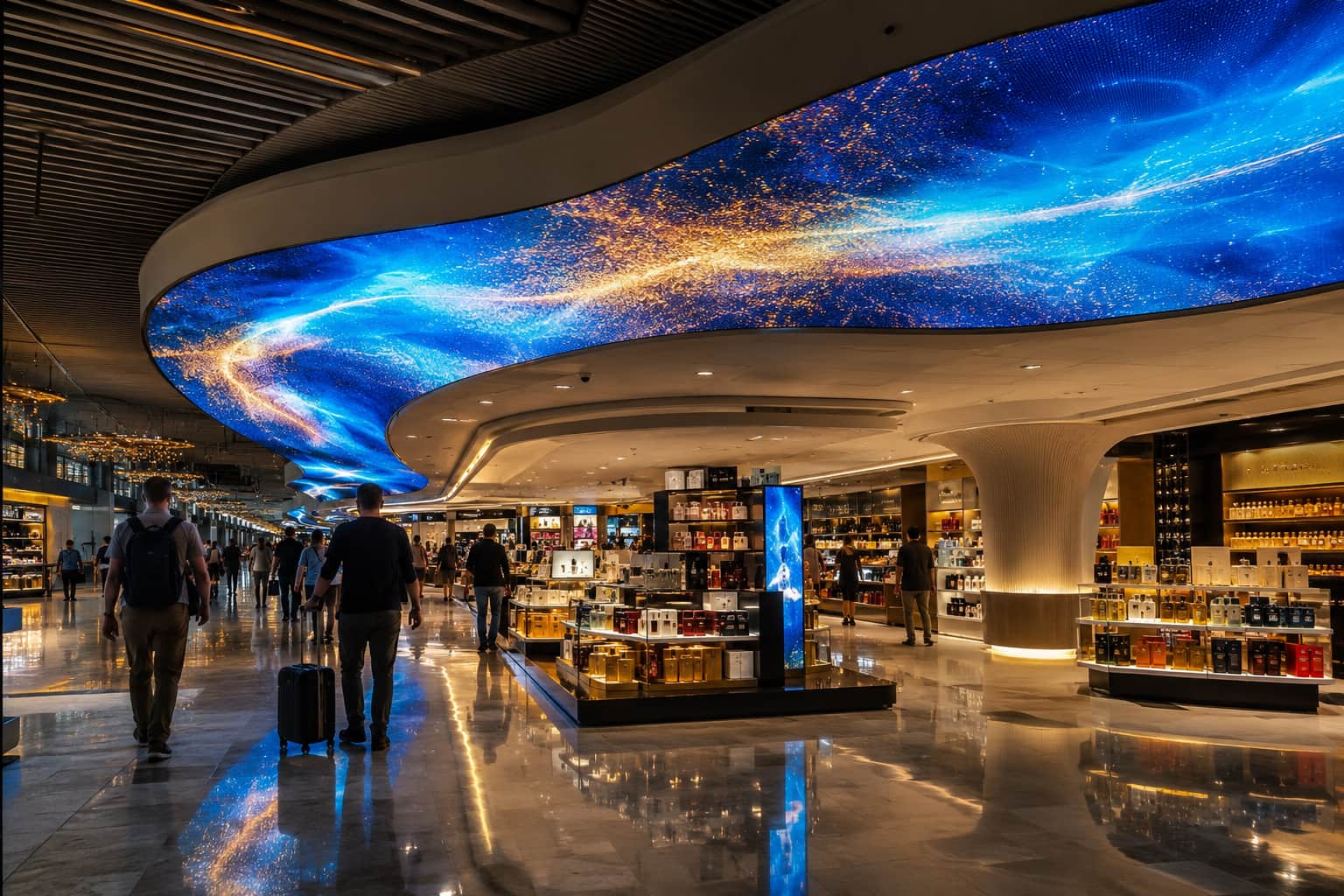
Curved check-in counter fascias are another strong use case. Traditional rigid panels leave visible gaps at joints or require the counter to be built flat around them. A flexible screen follows the counter’s natural curve seamlessly, keeping the visual line clean and the branding consistent across the full surface. Overhead and ceiling installations — arched entries, curved concourse ceilings, wave-form feature walls — follow the same principle. The screen conforms to whatever the architecture provides, rather than forcing a compromise between the display and the building.
In practice, a P1.5mm flexible LED screen installed in a busy airport hospitality space demonstrated exactly this: continuous operation under high passenger footfall, consistent image quality over long hours, and no structural modification to the existing interior. That real-world result is what separates flexible display technology from rigid alternatives on paper. The airport flexible LED display case study and the iSoft flexible LED display screen detail how that installation came together.
What to Consider When Choosing a Flexible LED Display Screen for Airports?
Not every flexible LED screen fits every airport project. However, a few factors matter more than others in a high-traffic, high-visibility terminal.
Pixel pitch is the first decision. For displays close to passengers — retail screens, information kiosks, check-in counter signage — a pixel pitch between 1.2mm and 1.9mm delivers the resolution needed for text and graphics to read clearly. Larger displays viewed from a distance, such as overhead wayfinding screens, work well at 2.5mm to 3mm with no visible loss of quality.
Bending radius determines which surfaces the screen can cover. Tighter curves — smaller columns, for example — need modules with a tighter minimum bending diameter. Therefore, always confirm this spec against actual site dimensions before ordering. It prevents costly rework.
Serviceability matters in live terminals. Airports run continuously, so maintenance must happen fast. Front-access service — removing and replacing a module from the front without touching the surrounding structure — is worth prioritising for any active terminal installation.
Finally, brightness should match the light conditions of the specific space. A concourse with heavy natural light requires 700 nits or more to maintain contrast. A lower-light retail corridor works well at 500-600 nits.
The Case for Flexible LED Display Screen in Every Airport Project
Rigid LED panels built airports’ earliest digital signage networks — and they served their purpose. But the category has real limits in a space defined by curved architecture, constant movement, and high visual standards. A flexible LED display screen removes those limits. It follows the building’s actual geometry, installs faster, and holds up under the specific conditions airports create: wide viewing angles, high ambient light, continuous operation, and close-range viewing.
Today, airports using flexible LED screens work with their architecture — not around it. Columns become display surfaces. Curved walls carry full-motion content. Irregular features that once stayed blank are now part of the visual experience. For projects that need that level of adaptability, the most common configurations include column-wrap installations, concave and convex wall-mount screens, and custom-curved ceiling displays. Each type is achievable with the right module spec and cabinet design.