
If you had asked an LED engineer five years ago whether they could achieve a pixel pitch of 0.9 millimeters on a Flexible LED Display surface, they would have immediately said no. They would have argued that it wouldn’t work on a mass-production scale and couldn’t meet the reliability requirements for commercial installations. A fine pixel pitch requires extremely precise chip alignment, with tolerances measured in micrometers. However, flexible substrates are subject to movement. They undergo slight bending, compression, and expansion due to temperature and mechanical stress.
Combining these factors inevitably leads to misalignment, microcracks, and premature failure. This is why most early flexible LED products had a maximum pixel pitch limited to 2.5 mm or wider, and why system integrators learned to view claims of “flexible fine-pitch” with skepticism. However, with technological advancements, MIP flexible LED module have gradually changed this landscape. They employ a packaging method in which the LED chips undergo special treatment before coming into contact with the flexible substrate.
The Engineering Conflict Nobody Talks About
In a standard SMD package, the bare LED chip is bonded to the substrate and sealed with epoxy resin. While this method is certainly viable, it requires the substrate to remain perfectly flat at all times. Any bending creates stress at the bonding points, and this stress accumulates over thousands of bending cycles. At a 2.5-millimeter pitch, the physical spacing between chips is sufficiently large, so minor substrate deformation will not cause catastrophic crosstalk between adjacent light-emitting devices. The real issue is not merely whether microchips can be used on flexible materials, but whether the connection between the chip and the substrate can withstand the mechanical stresses encountered in practical applications without reducing light output or causing malfunctions.
How MIP Flexible LED Module Packaging Actually Solves It?
MIP — Micro LED in Package — encapsulates the LED die inside a protective structure before it’s mounted to the flexible substrate. The die isn’t exposed to substrate flex forces in the same way an SMD chip is. The encapsulation absorbs and distributes mechanical stress, isolating the light-emitting element from the deformation happening at the substrate level. That’s the core insight. And it’s why MIP modules can do things conventional flexible modules can’t.
What the Specs Reveal
The indoor MIP flexible LED module is available in three pixel pitches: 0.9 mm, 1.2 mm, and 1.5 mm. This range caters to various needs, from close-range meeting room displays to large lobby screens viewed from medium distances. Individual modules are 300 × 168.75 mm, with cabinet sizes scalable to 300 × 506.25 mm, 300 × 675 mm, and 300 × 843.75 mm. All modules feature a native 16:9 aspect ratio, enabling direct display of 2K, 4K, and 8K resolutions without scaling artifacts after assembly. For permanent installation scenarios where absolute panel-to-panel flatness is essential, we offer die-cast aluminum cabinets.
Why IP65 + 15,000:1 Contrast on a Flexible Module Is Unusual
The MIP flexible LED module offers an IP65 rating—dustproof, moisture-resistant, impact-resistant, and antistatic. Unlike traditional flexible modules that rely on external coatings that scatter light and reduce contrast, MIP integrates its protection directly into the chip packaging. This ensures no light obstruction, achieving a rare 15,000:1 contrast ratio on a flexible surface with IP65 protection. Most indoor modules with this contrast are rigid, and most flexible ones with IP65 don’t reach this ratio. Additionally, MIP LED displays have a 170° omnidirectional viewing angle, making them perfect for installation on curved or non-flat surfaces, typical of flexible module applications.
Where 0.9mm Pitch on a Flexible LED Display Actually Gets Used
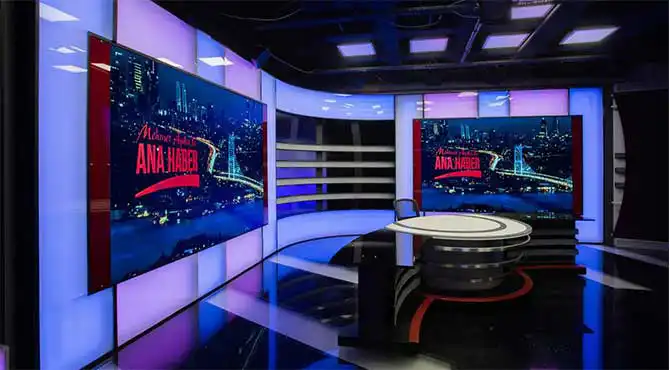
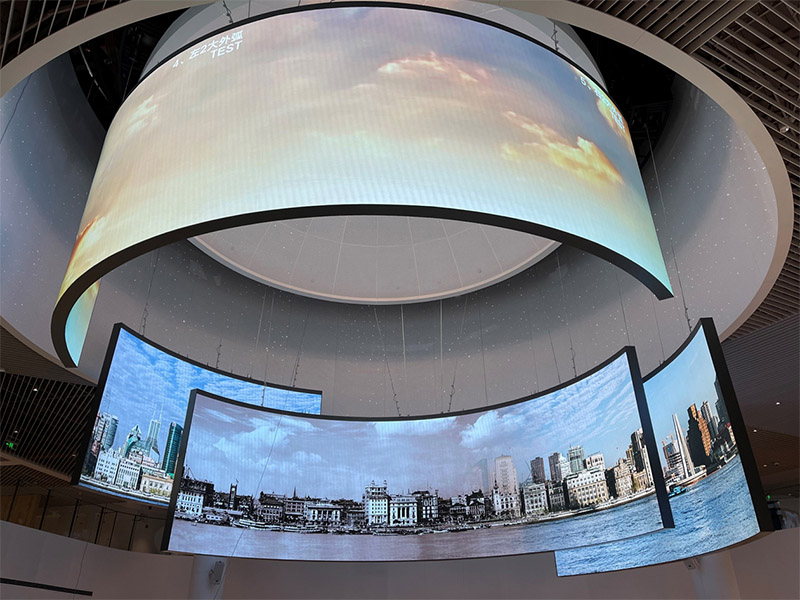
Proximity and curvature are key to this specification’s value. Museum installations, for example, benefit from curved displays where visitors stand close (1–1.5 meters). At 0.9mm pitch, individual pixels disappear, creating a seamless image. This also applies to executive briefing centers and high-end hospitality, where display quality reflects on the brand. A flexible LED display with 0.9mm pitch on a curved substrate offers design possibilities beyond rigid panels. Broadcast studios and XR environments also gain from the fine pitch, flexibility, and 16:9 aspect ratio, making it ideal for virtual production backdrops that require seamless curves and camera-friendly contrast.
The Trade-offs of MIP Flexible LED Modules
The use of fine-pitch technology on flexible substrates is not suitable for all projects. First, the cost is significantly higher than that of traditional flexible modules. For large-scale outdoor installations or events with a viewing distance of tens of meters, using a 0.9mm pitch is unnecessary and leads to high additional costs. Greater care is also required during the installation process. This high precision allows fine-pitch MIP modules to perform exceptionally well when viewed up close, but it also means that alignment accuracy during assembly is even more critical. Only experienced installers familiar with fine-pitch rigid panels can master the installation techniques effectively.
When a MIP Flexible LED Module Spec Sheet Stops Being a Question
Engineers have now fundamentally overcome the technical barriers that once prevented fine-pitch flexible displays from being used in close-viewing scenarios. MIP packaging technology protects the chip before it comes into contact with the substrate, which is why a 0.9-millimeter pixel pitch, IP65 protection rating, and 15,000:1 contrast ratio can now coexist on a single screen. Whether this solution is suitable for your project depends primarily on your viewing distance, budget, and the complexity of the curved geometry. Even engineers who once claimed that “flexible fine-pitch technology is not yet ready for mass production” are now adding it to their shortlists.