
Walk into two jewelry stores selling identical pieces. One has flat, cold overhead lighting. The other has a warm, layered glow that makes every stone look like it belongs in a magazine. You already know which one feels more expensive, and which one you’d rather buy from. That feeling doesn’t happen by accident. There’s a reason the second store looks the way it does, and it has everything to do with how the right LED display flexible system changes not just the light but the entire experience of being inside a jewelry store.
What is an LED Display Flexible Panel?
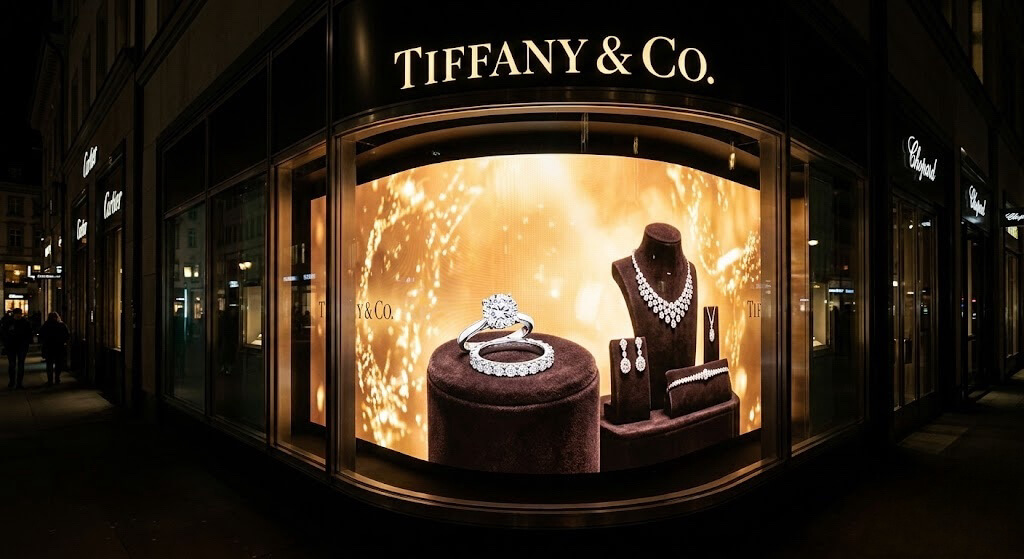
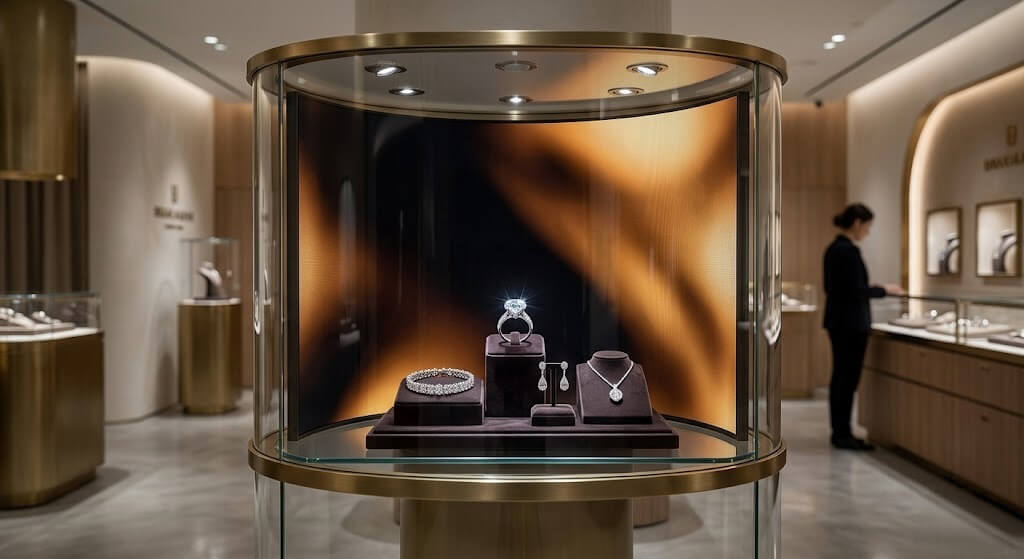
A flexible LED display works just like a standard screen, except it bends. It can wrap around cabinet pillars, follow a curved shop window, or flow along a ceiling with no straight edges in sight. Because the panels are built on a flexible substrate, they adapt to your space rather than the other way around. Most jewellery showcases aren’t flat. Pedestals are cylindrical, and windows follow curves. A rigid screen looks out of place in these settings, like a TV bolted into a boutique. A well-designed flexible LED display disappears into the environment, as if it were always meant to be there.
How does it help your jewellery shop stand out?
Indoor LED display flexible modules cover a pixel pitch range of 0.9mm to 3mm. If you’re not familiar with pixel pitch, think of it as the density of the image — the tighter the pitch, the sharper the picture. For a jewelry store where customers typically stand one to three meters from the display, a pitch of 1.5mm to 2mm hits the sweet spot: crisp, seamless, and indistinguishable from print quality at normal viewing distance.
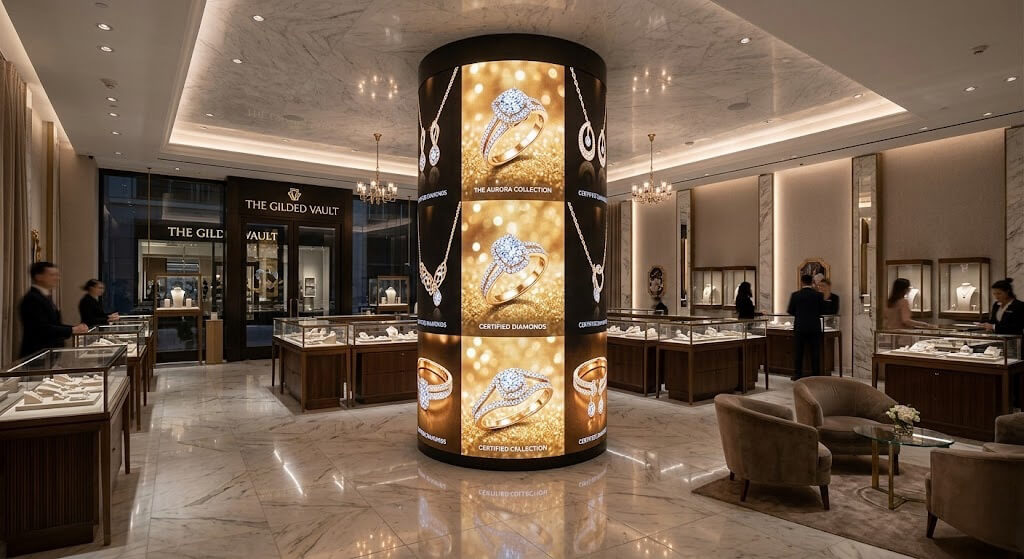
The modules bend between 135° and 180°, which translates to a minimum bending diameter of 306mm — tight enough to wrap a standard display cabinet column or follow the gentle curve of a showcase fascia without any modifications to the cabinetry itself. No cutting, no structural changes. The rubber module casing handles the curve naturally.
Installation is magnetic. Each module snaps into position cleanly and holds in place with strong magnets, keeping the screen surface flat and seamless even across curved configurations. That same magnetic design makes maintenance straightforward: a technician can remove and replace a single module from the front without dismantling surrounding fixtures — no tools, no disruption, no turning your shop into a building site.
The refresh rate runs at 3,840Hz on fine-pitch models. In practical terms, that means zero visible flickering — not even when customers photograph the display on their phones. In a jewelry environment, that matters more than in most retail settings. Customers don’t browse quickly. They stand close, compare items carefully, and often return to look again. A display that feels comfortable to look at for twenty minutes — no eye strain, no subtle pulse — is one that keeps customers in the space longer. The color temperature is also adjustable from 3,200K to 9,000K, so the display can be tuned to complement warm lighting rather than clash with it. The dead pixel rate is rated below 0.0003, and the rated lifespan is 100,000 hours — both figures that matter when a display runs during every trading hour of the year.
Can it be installed in a small jewellery shop?
Certainly. The modular design means there is no minimum size requirement. Whether a boutique installs a single curved panel behind a display cabinet or a flagship store fits twenty across an entire interior, the process is equally straightforward. The system scales to the space and the budget.
The installation itself causes far less disruption than most shop owners expect. Each module weighs around 190 to 220 grams, and the overall system comes in at under 8kg per square meter — light enough to mount on standard wall surfaces and display cabinet structures without reinforcement. The magnetic snap-fit method means curved shop windows, display cabinet back panels, and column wraps all go in without major construction or days of closure.
One point, smaller shops should think through before ordering is pixel pitch. In a boutique, customers often stand within a meter of the display cabinet. At that distance, a 1.2mm or 1.5mm pitch looks noticeably sharper than a 2.5mm option — the difference is visible, and it matters when the products being displayed are fine jewelry. Getting that decision right at the start saves the cost and disruption of upgrading later.
How LED Display Flexible Pricing Works?
No single price exists for an LED display flexible system — cost comes down to three things: pixel pitch, display area, and installation complexity. Pixel pitch drives the most variation. A P1.5mm module costs more than a P2.5mm module of the same size — but in a store where visual quality is part of the brand, skimping on pitch is a trade-off that tends to come back around. Area scales linearly. Modular systems let you phase the investment — window display first, showcase surrounds later — without compatibility issues. Installation depends on the surface. Flat panels are straightforward. Column wraps take more time. Define your area and pixel pitch, then request a formal quote.
LED display flexible adds value to jewellery shops
Better than you’re probably picturing right now. The most popular application is the showcase background, a curved LED display flexible screen that shifts on demand. Deep black makes diamonds pop. Warm gold complements yellow gold pieces. A soft ambient loop adjusts with the season or time of day. The same physical space does significantly more work.