
A standard display plays content. A 360 degree rotating LED screen plays content and moves at the same time — and that distinction changes everything about how audiences experience a space. The screen itself becomes part of the visual. That’s not a feature upgrade. It’s a fundamentally different category of display technology.
360 Degree Rotating LED Screen Turns the Display Itself Into the Visual
With a conventional screen, the hardware disappears. The audience looks through it, at the content. That’s by design — flat screens are meant to be neutral carriers. A 360 degree rotating LED screen breaks that assumption completely. When the structure rotates, transforms, or unfolds, the screen ceases to be invisible. The movement is the content. Audiences aren’t watching what’s on the display — they’re watching what the display does.
This is what makes a kinetic LED display fundamentally different from anything in the standard category. The DNA Rotating LED Screen, for instance, supports multi-dimensional shape transformations driven by an intelligent mechanical transmission system — producing a flowing, synchronized rotation effect that no static panel can replicate, regardless of resolution or brightness spec.
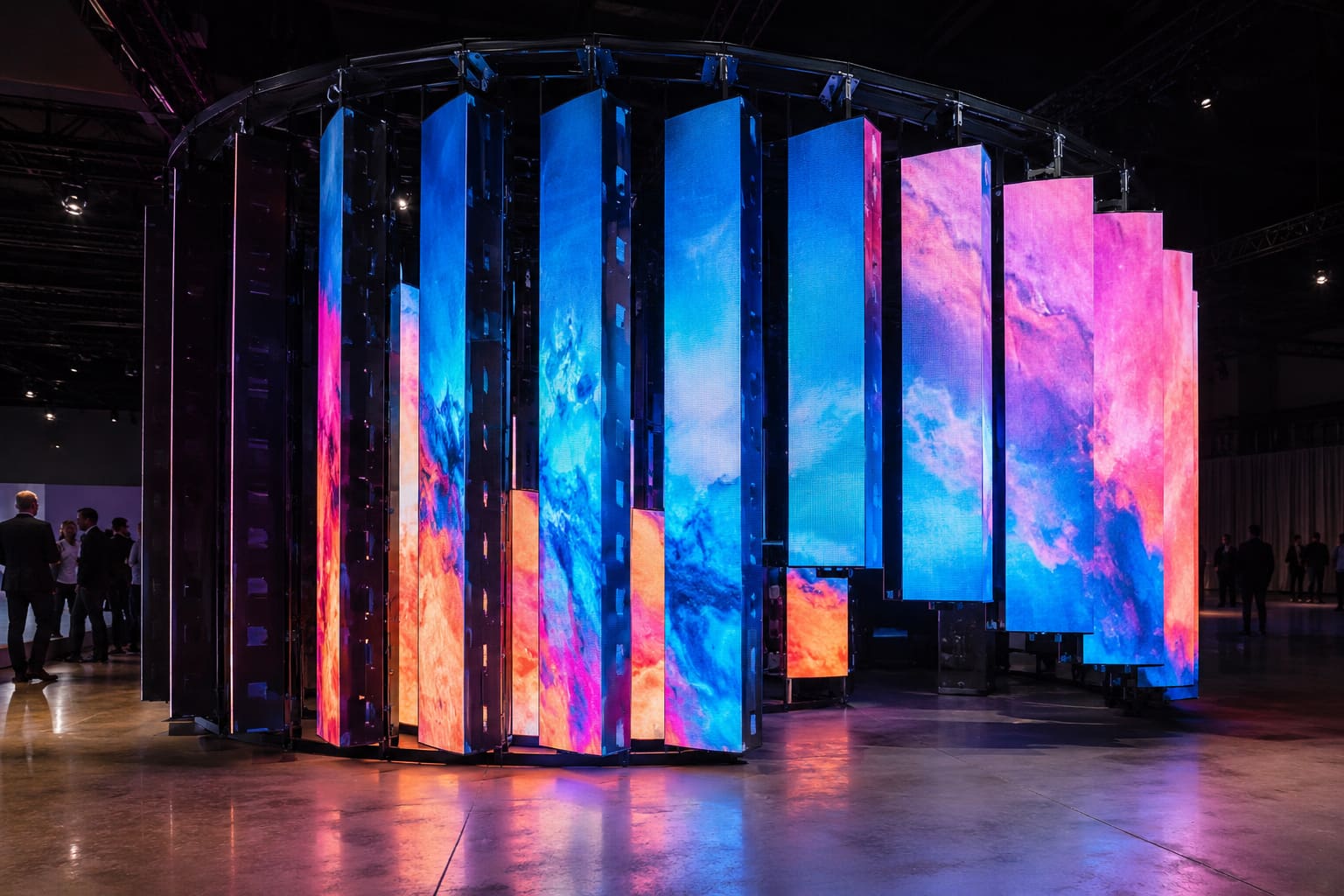
360 Degree Rotating LED Screen Reaches Audiences, a Flat Screen,n Misses
A flat screen has one face. Everyone who reaches it has to be standing in front of it. That’s a significant spatial limitation — especially in open environments like exhibition halls, retail floors, or event venues where foot traffic moves in every direction. A 360 degree rotating LED screen solves this by design. Dual-sided flat-screen configurations and dual-sided curved-screen options mean content is visible from multiple angles simultaneously.
As the screen rotates, different audience positions receive the visual — not sequentially, but as a continuous, uninterrupted experience. In practice, a single motorized LED screen installation in a central floor position can engage viewers at 180 degrees or more — coverage that would otherwise require multiple LED screens, more mounting infrastructure, and significantly more content management overhead.
Creates Depth That Flat Screens Cannot
Flat screens produce two-dimensional output on a two-dimensional surface. The illusion of depth comes entirely from the content — 3D renders, perspective tricks, layered visuals. The hardware itself adds nothing to the spatial experience. A 360 degree rotating LED screen contributes depth physically. As the structure moves through space, it occupies volume. The eye tracks motion in three dimensions — and that tracking creates a sense of presence that no amount of clever content design on a flat panel can manufacture.
This doesn’t come at the cost of image quality. Pixel pitch options from 1.2mm to 2.6mm ensure that close-range viewing — common in showroom and retail environments — delivers sharp, accurate imagery throughout the full rotation cycle. The dynamic mechanical LED screen architecture is built to maintain display integrity in motion, not just at rest.
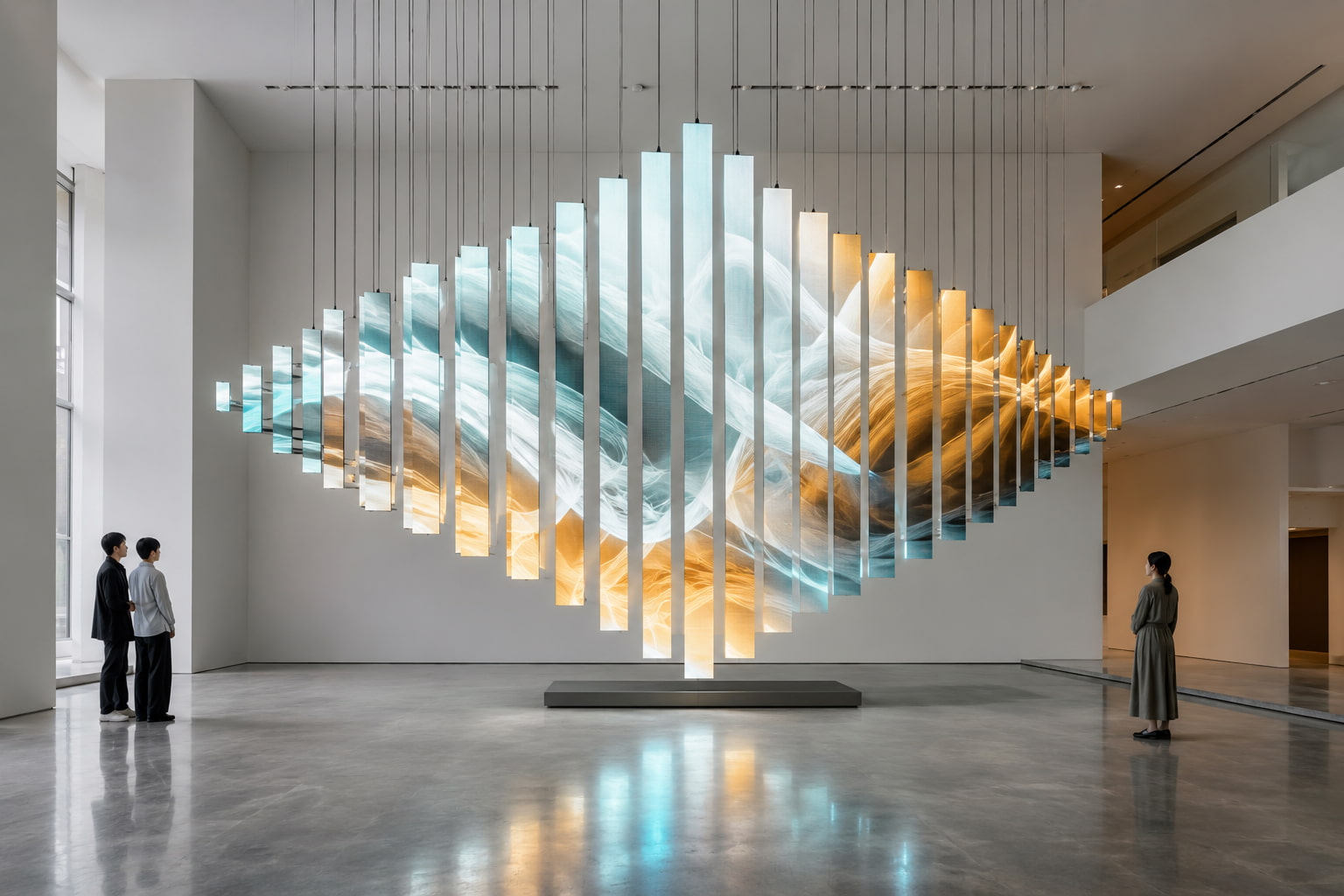
Fits Spaces a Standard Display Cannot
A standard display is a rectangle. It mounts flat, occupies a defined footprint, and stays where it’s installed. That works in most environments — but it means the display has to fit the space, not the other way around. 360 degree rotating LED screen inverts that relationship. Modular cabinet sizes of 160×160mm and 250×250mm allow configurations to be assembled, reconfigured, and scaled to meet the space’s actual needs. A compact indoor showroom might run a tighter cluster. A large event venue might deploy an extended suspended installation. The same system adapts to both.
This modularity also reduces installation time and simplifies reconfiguration when spatial requirements change — a practical advantage that flat panel systems, with their fixed mounting logic, rarely offer.
360 Degree Rotating LED Screen Changes Shape
Once a standard display is mounted, its form is set. The only thing that changes is what’s shown on screen. 360 degree rotating LED screen can change its physical configuration — not just its content. The 3D Kinetic LED Screen supports staggered panel arrangements, dynamic opening and closing effects, and modular splicing into non-standard forms. Each activation can present a different structural shape, which means the visual impact doesn’t flatten over repeated exposure the way a static installation inevitably does.
For brand environments, that matters. A transformable LED surface that reconfigures for different campaigns or events delivers genuine variety — not just a playlist refresh, but a physically different installation each time.
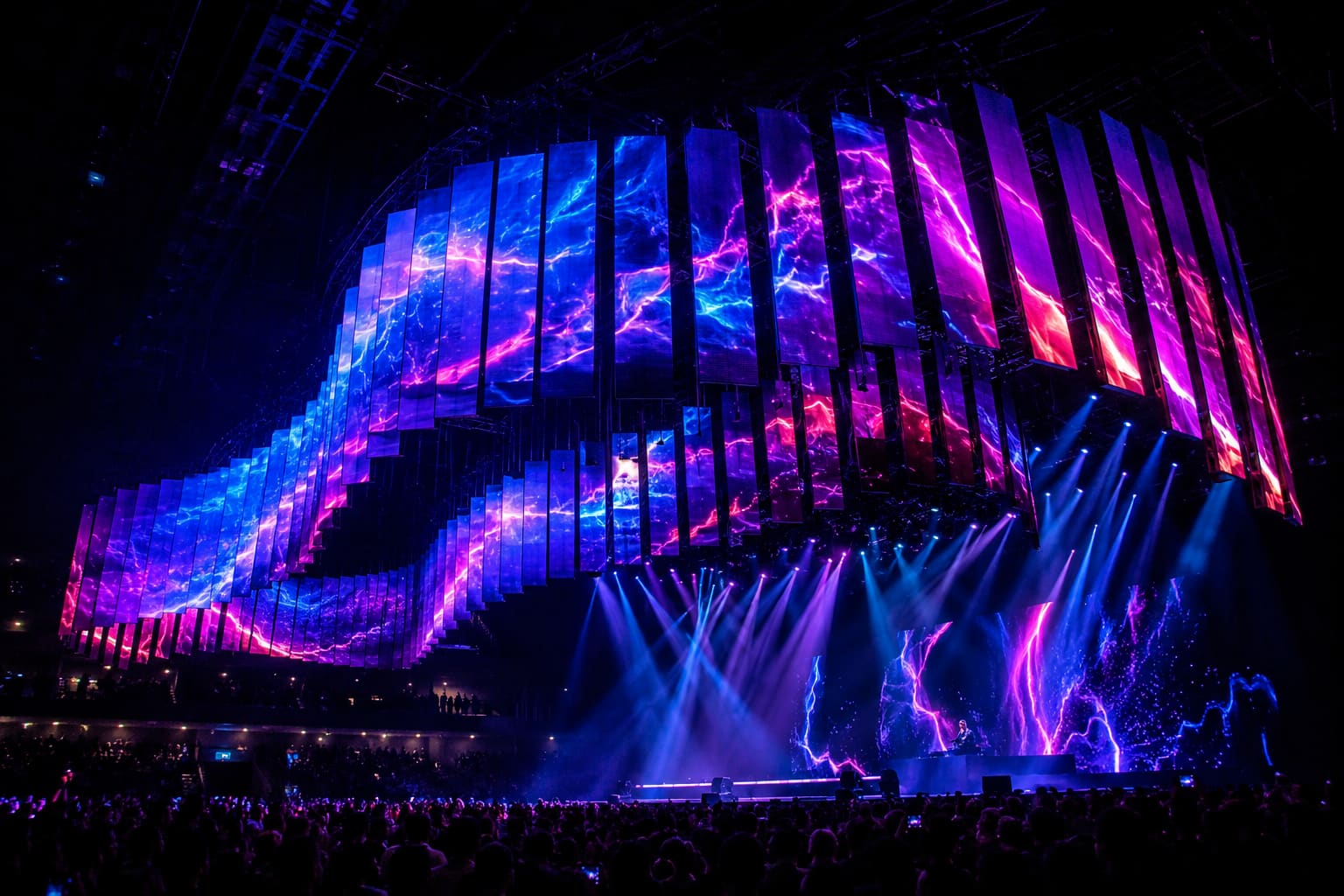
The 360 degree rotating LED screen offers features that standard displays simply cannot match
The gap between a 360 degree rotating LED screen and a conventional flat panel isn’t a matter of incremental improvement. It’s structural. Standard displays don’t move — so they can’t make movement part of the message. They face one direction — so they can’t reach audiences on multiple sides of a space. And they hold a fixed shape — so they can’t reconfigure to match changing environments or campaign needs.
None of these is fixable with better content or a higher resolution spec. They’re hard limits built into the flat panel format itself. A rotating LED screen doesn’t work within those limits — it operates entirely outside them. This behavior is grounded in a well-documented optical principle — persistence of vision — which rotating LED systems exploit to sustain seamless imagery across a full rotation cycle. For any environment where the display needs to do more than show content, that difference is the whole point.