
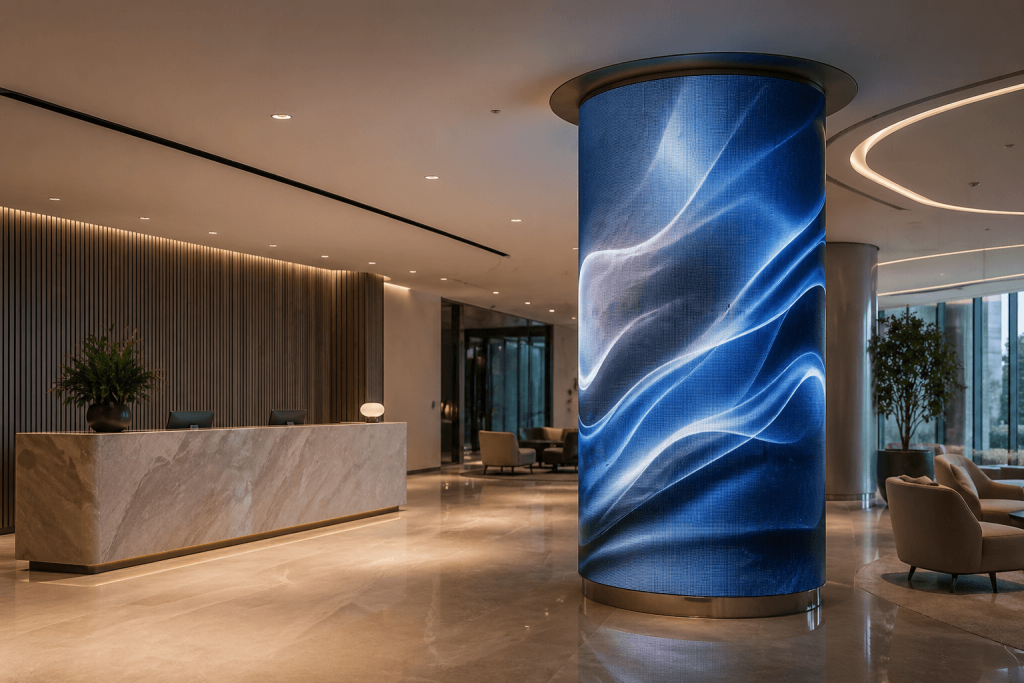
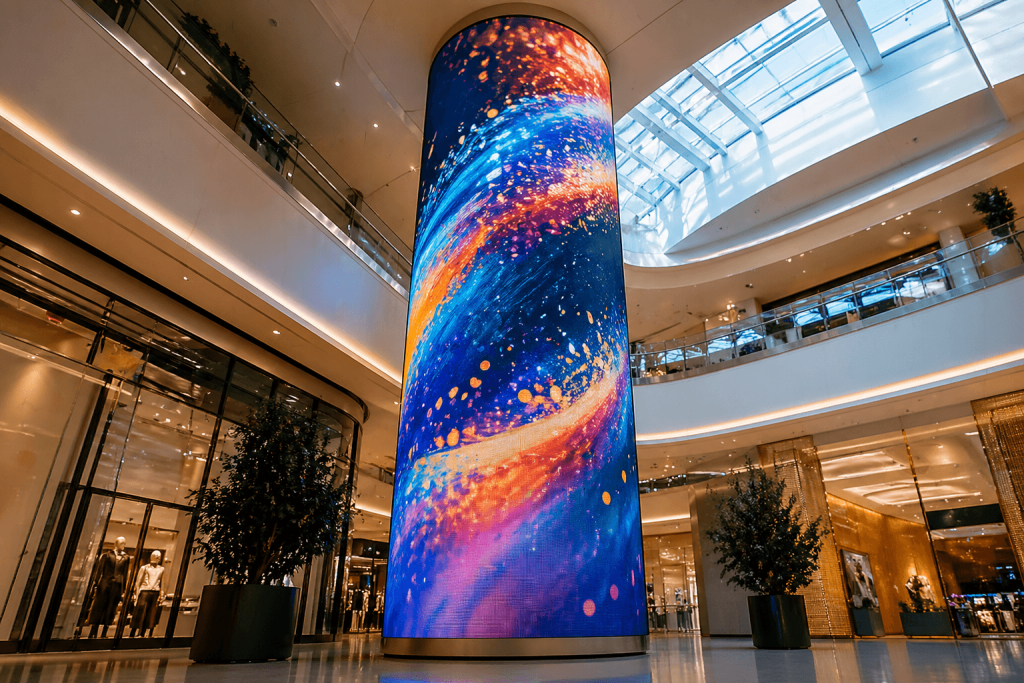
Yes. A flexible LED screen can wrap around indoor columns when the project team checks the column diameter, bending angle, pixel pitch, module size, seam layout, and maintenance access before installation. This type of display often appears in hotel lobbies, shopping malls, exhibition halls, retail stores, and corporate reception areas. It turns plain structural columns into active digital display surfaces without building a full flat video wall. The result depends on more than the word “flexible.” The LED module must follow the column curve without visible seams, edge pressure, or service problems. A smooth column display also needs the right viewing distance, wiring path, mounting structure, and future maintenance plan.
Why Flexible LED Modules Work on Columns
A flexible LED screen works on columns because the module structure can bend across non-flat surfaces. JR Visual’s LED module series uses flexible substrate material and supports a bending angle of 0–30°, depending on the model. This range allows the modules to follow curved, cylindrical, and wavy surfaces rather than being limited to flat walls. That bending ability matters for indoor columns. A flat LED cabinet creates hard edges around a round pillar. It may turn the column into several broken display faces. A flexible LED module follows the curve more naturally, so the screen looks more like one continuous surface.
Pixel pitch also affects the viewing result. JR Visual’s LED module options cover 0.9mm to 4mm, including P0.9, P1.2, P1.5, P1.8, P2, P2.5, P3, and P4. Smaller pixel pitch works better where people stand close to the column, such as hotel reception areas, retail stores, and exhibition booths. A wider pixel pitch can work in larger halls or atriums where viewers stand farther away. Module size also affects the wrap. JR Visual offers flexible module sizes, including 240×120mm, 320×160mm, 250×250mm, and 480×320mm. Smaller modules usually handle tighter curves and seam adjustment more easily. Larger modules can reduce the number of parts, but they need enough column diameter and a clean layout.
Which Indoor Columns Work Best for a Flexible LED Screen?
A flexible LED screen works better on large round columns, wide curved pillars, and smooth architectural columns. These structures do not force the screen into an aggressive bend. The larger the column diameter, the easier it is to maintain a smooth LED surface and reduce pressure on the module, PCB, mask, and mounting structure. The surface condition also matters. A clean, stable column provides the flexible LED panel with a better base. Heavy grooves, uneven stone, exposed pipes, sharp edges, or irregular cladding can create shadows, warped seams, or pressure points after installation.
Some columns should be avoided or redesigned before ordering. Very small columns may push the module beyond its safe bending range. Damp areas, heat-heavy zones, and high-impact public walkways can increase maintenance risk. A column with no space for cables, power, signal control, or future module replacement should not move straight into production.
How to Install an Around an Indoor Column?
Start with measurement before choosing the product. Measure the column diameter, height, usable display width, and surface condition. A round column and a square column with rounded corners need different layout plans. The installer should also confirm whether the display will wrap fully around the column or cover only the front-facing arc. Next, match the pixel pitch with the real viewing distance. If people walk within one or two meters of the column, P0.9, P1.2, or P1.5 can help reduce visible pixel structure. If viewers stand farther away in a lobby, hall, or atrium, P1.8, P2, P2.5, or P3 may be enough. The goal is to match image clarity with how people actually move through the space.
After that, choose the LED module size and plan seam placement. Seams should be avoided in the main viewing area when possible. On a 360-degree wrap, seam consistency matters because people may walk around the full pillar. On a partial wrap, the front visual area should stay as clean as possible. Mounting and maintenance also need early planning. JR Visual’s LED modules use standardized dimensions and interfaces, with magnetic or snap-on structures that support easier installation and replacement. The project still needs space for power supplies, signal routing, control access, and future module removal. After installation, the team should inspect brightness, color consistency, seam alignment, curve smoothness, and viewing quality from different angles.
Choosing the Right Flexible LED Screen for Your Indoor Column Project
A flexible LED screen can wrap around indoor columns, but the column and screen must function as a single system. The column diameter must allow a safe bend. The surface needs to support stable mounting. The pixel pitch should match the viewing distance. The module size should create a clean curve without difficult seams. Maintenance access should be planned before installation starts. For indoor column projects, confirm the column measurements first. Then match the flexible LED Display product line to the curve, viewing distance, and installation method. JR Visual’s iSoft, iFlex, iSoft Max, and iSoft MIP options offer project teams a range of pixel pitches and module sizes.
If the column is large, smooth, easy to wire and service, a flexible LED panel system can create a clean indoor column display. If the column is too small, uneven, hard to access, or exposed to repeated impact, adjust the design before ordering. The screen can bend, but the project still needs the right conditions to keep the wrap stable and smooth, and to maintain it.