
As an LED display manufacturer serving merchants and store designers, determining the appropriate size for a see through LED display begins with considering measurable goals and practical constraints, rather than a single, intuitive size. Size impacts the display’s visual impact, content readability at varying distances, required power, and structural support. JRVISUAL’s StarLink transparent LED film displays feature a modular design, are lightweight and portable, and are customizable by module height and width. These module dimensions determine the total physical footprint, the number of seams, and the service strategy.
Three key data points also need to be collected: the exact glass area available for the screen, the viewing distance, and the content strategy. This allows you to balance pixel pitch, transparency percentage, and module size to achieve the desired clarity while maintaining storefront visibility when the display is not in use.
Conducting Site Measurements Before Determining See Through LED Display Size
Before selecting modules or pitch, accurately measure the mounting aperture and viewing conditions, since these define feasibility and display performance. Start by recording the glass dimensions and any structural obstructions that may affect module layout. Then map viewing distances, whether users are reading content at around one meter or passing by at seven to twelve meters, where larger visuals and motion matter more.
Also, evaluate ambient light and reflections, since a screen suited for a dim indoor space may require higher brightness and adjusted transparency in direct sunlight. Finally, check local signage rules and building codes that may limit size or brightness. Define key targets such as reading distance, image uniformity, and minimum transparency, then use these inputs when discussing module sizing with the See through LED display supplier.
Choosing pixel pitch, module size, and transparency to balance readability and see-through effect
Choosing pixel pitch, module size, and transparency is key to sizing decisions, as they control content detail and how much of the storefront remains visible when the screen is off. Pixel pitch defines viewing distance: 2.5–3.9 mm works for close merchandise displays within 1–3 meters, while 6.25–10 mm suits longer pedestrian viewing distances.
Transparency balances daylight visibility with display contrast. Higher transparency preserves the interior view but requires more brightness and may reduce contrast, while lower transparency improves visual impact but blocks more of the storefront. Since the StarLink series allows customizable module sizes, JRVISUAL can adjust modules to fit glass dimensions and avoid seams in key viewing areas, while also recommending a balanced pitch, transparency, and module setup for both readability and storefront openness.
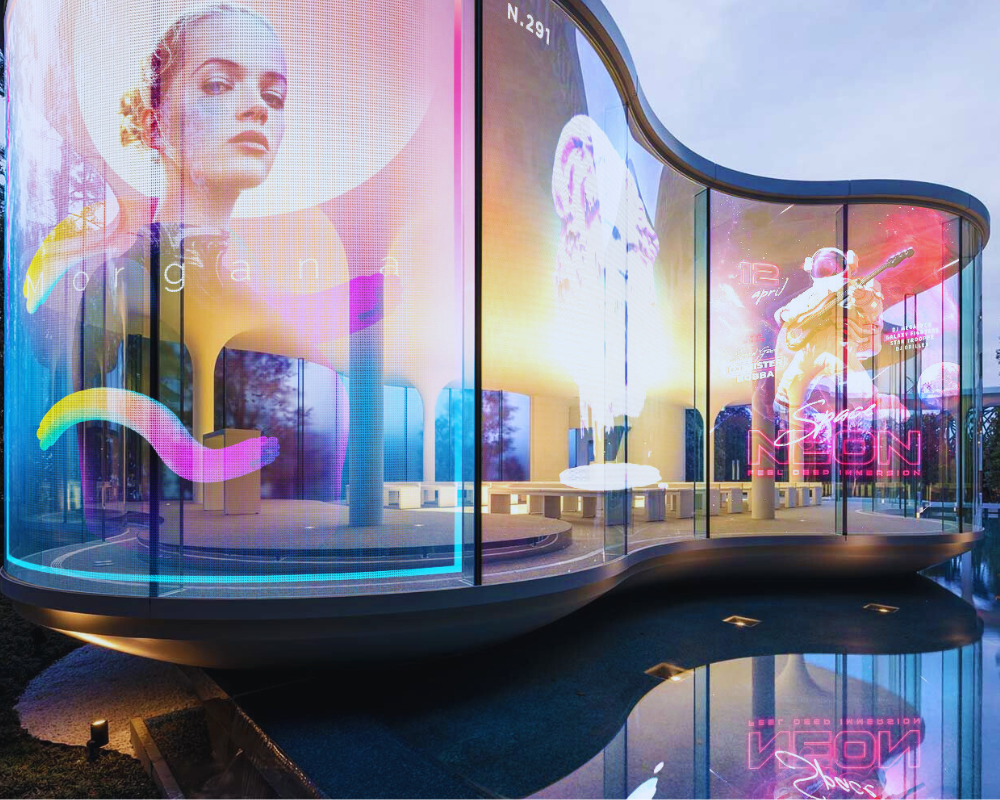
Calculate resolution, content layout, and viewing angle to determine the practical dimensions of a see through LED display.
Once physical size and pixel pitch are defined, convert them into pixel resolution to confirm clarity. Divide width and height by pixel pitch to estimate horizontal and vertical pixels, then match this with content needs. Single-line headlines need sufficient pixel height for readability, while video content performs better at medium viewing distances and resolutions around 720p or higher. For example, a 4 m × 2 m window with 3.0 mm pitch gives about 1,333 × 667 pixels, suitable for medium-detail visuals and text.
Also consider viewing angle and eye alignment. First estimate viewing distance, then verify that headline stroke width and icon size meet human readability limits. If the full glass area lacks enough pixels for close viewing, avoid uniform distribution. Instead, place higher-density modules in the text zone so key information uses the highest resolution area.
Consider integration, installation, power, and maintainability based on size
The physical size must align with real-world installation constraints, including structural, power, signal, and maintenance considerations. Mounting options include clamp-rod suspension, direct glass adhesion for a seamless look, or slim-frame installation hiding wiring. Each method affects span and service access, so large displays are often divided into module groups aligned with glass panes to reduce load and ease maintenance.
Power and control systems scale with the display area. Larger screens need multiple power injection points to avoid voltage drop and maintain brightness consistency, while long cable runs may require repeaters or fiber converters. Before final sizing, confirm module chain limits, power consumption per module, and required service access points. Installation labor cost should also be considered when choosing module size. As a See through LED display supplier, we help balance size, maintenance, and installation constraints.
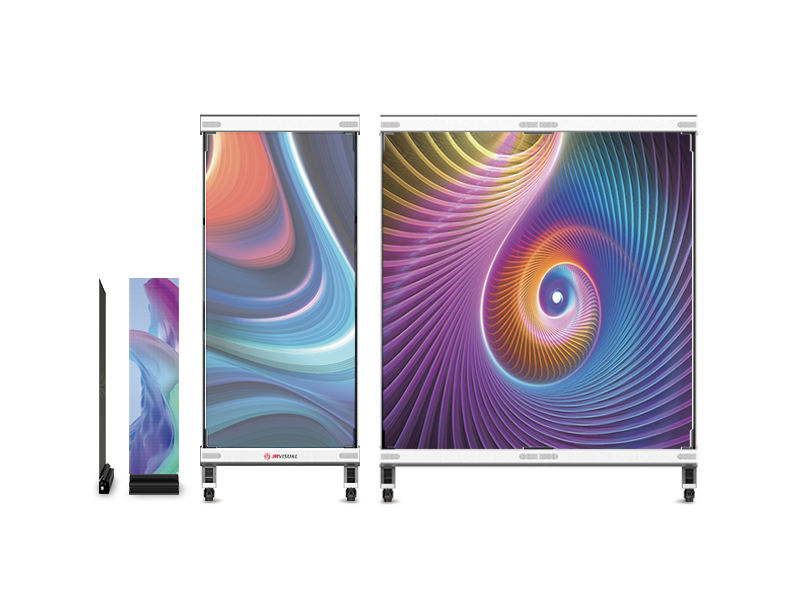
Consider the final size based on a comprehensive set of factors.
Determining the size of see through LED displays for enhancing a storefront’s performance is a comprehensive process. It begins with precise site measurements to clearly define the viewing distance and intended content. These inputs are then translated into pixel pitch and module size selections that strike a balance between readability and transparency. Finally, a practical installation and procurement plan is developed, considering installation, power consumption, maintenance, and cost. Since module size affects joints, weight, and structural needs, JRVISUAL can customize StarLink Film panels to fit your glass geometry and provide photometric models to evaluate different size options in your actual environment.
Common Questions When Choosing a see through LED display Size
Q1. How do I choose pixel pitch for a See through LED display?
A1: Based on viewing distance. ~1.5–2.5 mm for close viewing, 2.5–4.0 mm for normal pedestrian distance, and 4.0 mm+ for far viewing.
Q2. Are larger screens always better?
A2: No. Larger screens increase impact but may reduce transparency and require higher brightness. Performance depends on content, distance, and lighting.
Q3. What transparency level is needed?
A3: 60%+ for clear store visibility, 30–60% for stronger display contrast at night.
Q4. Can different modules or pixel pitches be mixed?
A4: Yes, if the control system supports it. It allows high-res zones for text and lower-res areas for video, with proper content mapping.