
Most spec sheets list a pixel pitch number and leave you to figure out the rest. For a standard flat panel, that’s manageable. For a rotating LED display, the resolution story is more layered. Panels move, fold, and curve, simultaneously displaying content on two sides. A single number doesn’t cover that. Here’s what the specs actually mean, and how to read them before you commit to a project.
What Rotating LED Display Resolution Actually Measures
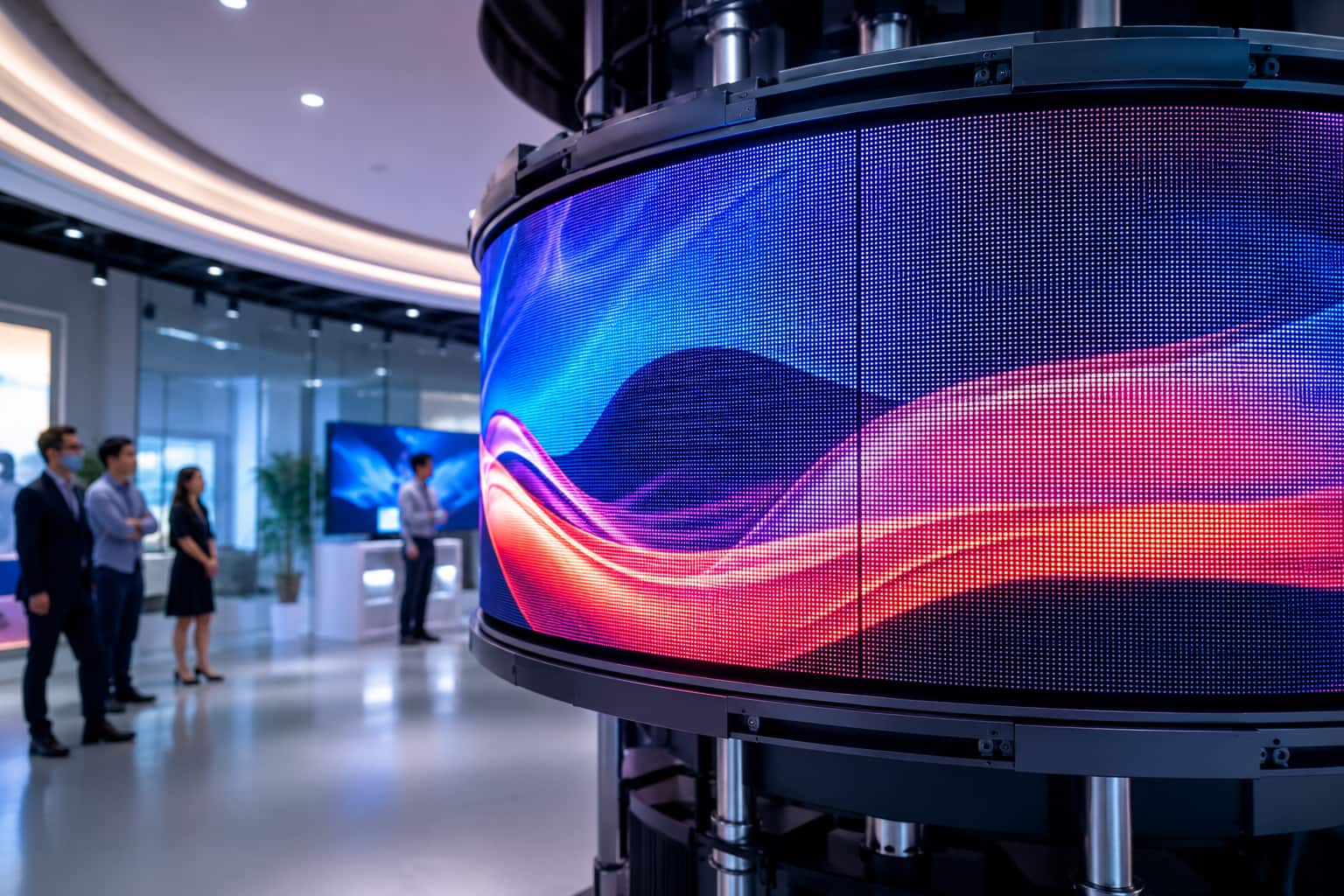
Resolution, in any LED display, describes how many pixels fit within a given area. The industry metric is pixel pitch — the distance in millimeters between the centers of adjacent LED clusters. A P1.2mm display places pixels 1.2mm apart. A P2.6mm display places them 2.6mm apart. A smaller pitch means more pixels per square meter. That translates directly to sharper, more detailed images at close range. This relationship holds for rotating LED displays just as it does for fixed panels — but the context changes significantly.
On a rotating LED display, the screen isn’t stationary. Panels physically move, rotate, and reconfigure. As a result, the resolution you see at any moment depends on more than pixel pitch. It also depends on which face of the display is active, what angle the panel has rotated to, and how content has been mapped to a non-flat surface. That’s why pixel pitch alone doesn’t capture the full picture for this display category.
How does pixel pitch affect visual quality?
This is where real-world differences become measurable. Take the DNA Rotating LED Screen as a reference. The double-sided curved configuration at P2mm delivers a whole-display resolution of 640×960 pixels per side. Step up to a taller build, and that same P2mm pitch scales to 640×1,600 pixels per side. The pitch hasn’t changed — but the increased panel count adds significantly more pixel real estate.
Switch to the double-sided flat model at P1.875mm. The resolution reaches 384×1,280 pixels per side across a 720×2,400mm surface. A neighboring configuration at P1.953mm achieves the same 384×1,280 pixels across a 750×2,500mm frame. The pitch difference is less than 0.1mm. However, it affects how content renders on curved versus flat module formats — particularly at viewing distances under 2 meters. For buyers, the takeaway is straightforward. At viewing distances below 3 meters — retail showrooms, corporate lobbies, exhibition booths — a pixel pitch of P1.2mm to P1.9mm renders fine text and detailed graphics cleanly. Beyond 4–5 meters, P2mm to P2.6mm delivers equivalent perceived sharpness at a more favorable cost-per-module ratio.
Module Size and Its Role in Rotating LED Display Resolution
Pixel pitch tells you pixel density. Module size tells you how those pixels are physically packaged. For rotating displays, that distinction matters more than most buyers expect. A 160×160mm module at P1.2mm contains 133×133 pixels — roughly 17,700 pixels per module. A 250×250mm module at P2.6mm contains about 96×96 pixels, or just over 9,200 per module. In other words, the first format packs nearly twice the pixel density into a smaller footprint.
This matters for rotating displays because the mechanical structure places real constraints on module arrangement. The motor system, rotating axle, and layer stacking all limit how modules can be configured. Because of this, each module format is engineered specifically to bend, fold, or stack without creating pixel gaps at the seams. Smaller modules also offer finer granularity for reconfiguration. When a display rotates or opens through a motion sequence, the visible seam between modules follows the mechanical joints. Tighter module sizing reduces that perceptible gap during motion. That detail doesn’t appear on any resolution spec sheet — but it directly affects what the viewer actually sees.
Resolution in Real Deployment Scenarios
Three deployment contexts drive most rotating LED display projects: retail environments, trade show stages, and permanent corporate showrooms. Each has different resolution requirements — not because the hardware changes, but because viewing behavior does.
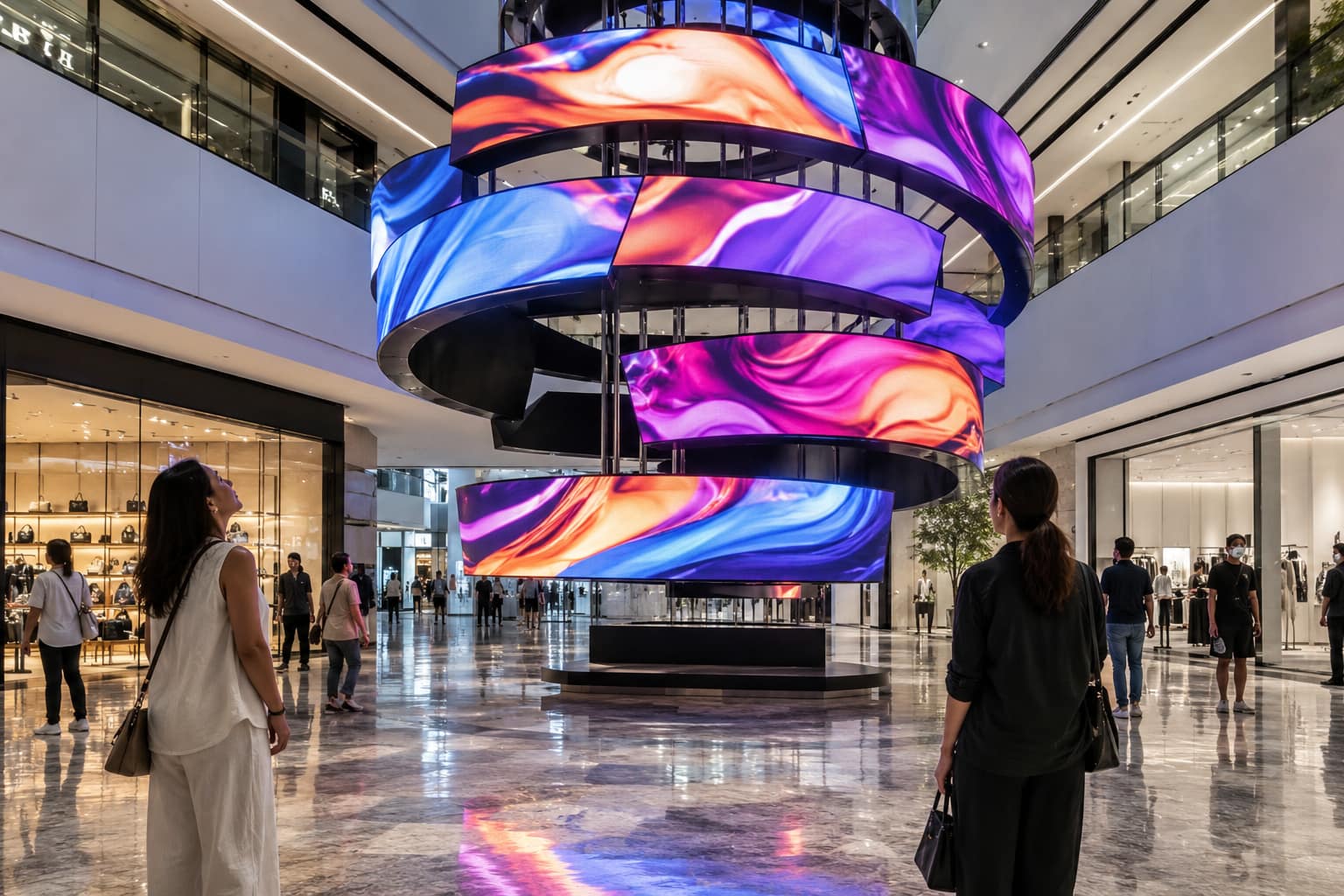
In retail — mall atriums, flagship store windows, brand activations — viewers pass within 1–3 meters of the display. At that range, pixel pitch is clearly visible. Therefore, P1.5mm to P1.9mm is the standard selection for these environments. A 160×160mm module at P1.9mm renders product imagery and brand graphics at a level of detail that holds up to close scrutiny. The 3D Kinetic LED Display at 500×500mm with P1.9mm or P2.6mm options serves this range well, with P1.9mm the stronger choice for content-heavy activations.
Trade show and event stages operate at longer viewing distances — typically 5 meters and beyond. Here, P2mm to P2.6mm performs effectively. Total resolution of the assembled display matters more than per-module density. As a result, larger configurations built from 250×250mm modules at P2.6mm deliver a strong visual impact without the cost premium of fine-pitch options. Corporate showrooms sit between these two poles. Viewing distances range from 2 to 6 meters, depending on room geometry. Moreover, the content mix — brand narrative, product demos, data visualization — often demands sharper rendering than event signage. P1.875mm to P2mm is the practical sweet spot for controlled indoor environments.
Where Rotating LED Display Resolution Ends and Real Performance Begins
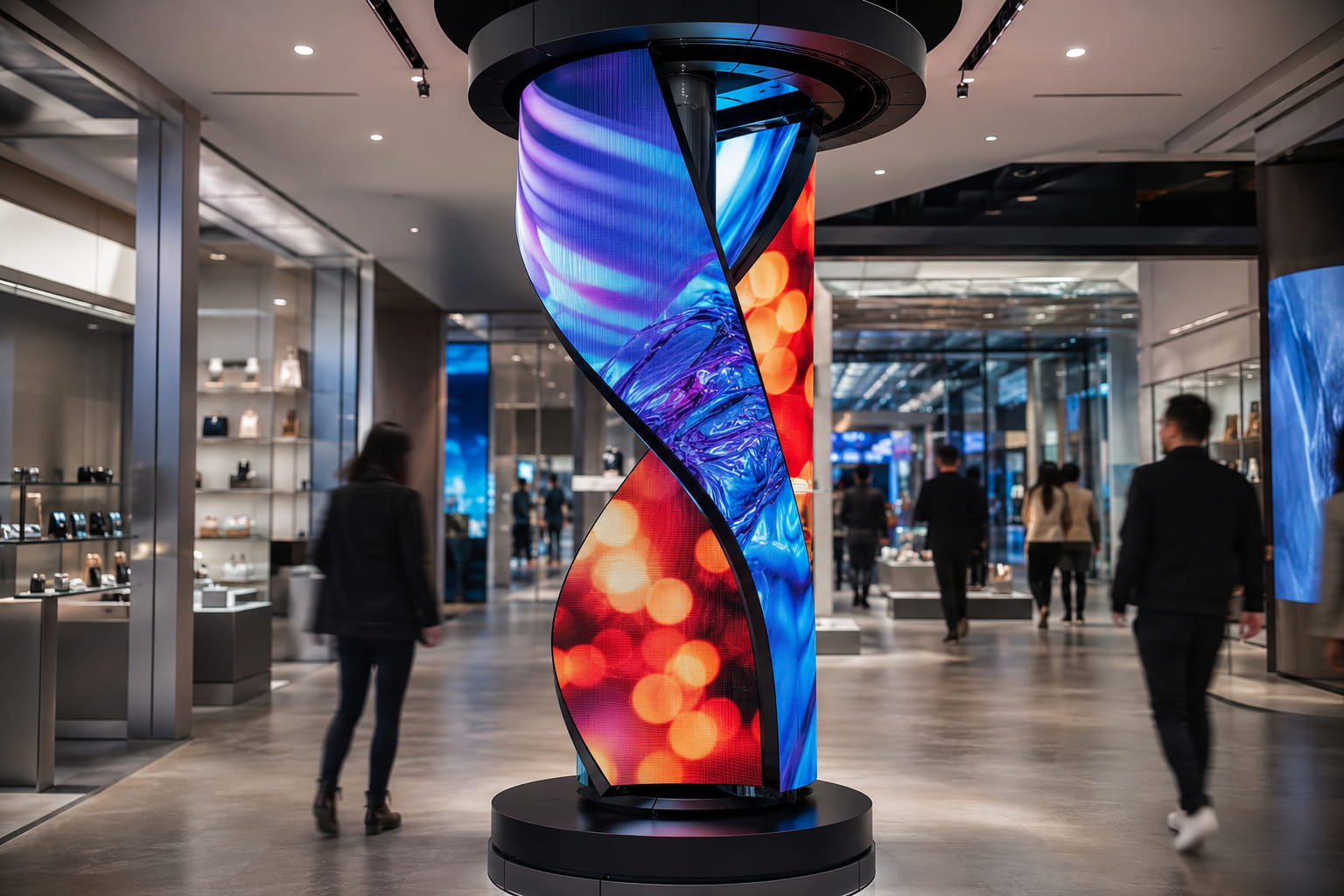
A rotating LED display delivers its visual experience through three systems: the display hardware, the mechanical motion system, and the content mapped to it. Resolution governs the first. The other two operate independently, and either can undermine whatever the panel spec promises. The DNA Rotating LED Screen supports 360° unlimited rotation with motion scripts synchronized to video content. At P1.9mm, the panel renders sharply. However, if the motion sequence rotates the display through an angle where the active face is partially obscured, the viewer won’t see that resolution. They’ll see a blur, a partial frame, or content that doesn’t track the panel’s position.
Motion sync precision is what separates a technically capable rotating display from one that performs reliably in a live environment. The same applies to module construction. A flexible module that holds its pixel geometry through repeated rotation cycles maintains its spec over time. One that degrades under mechanical stress doesn’t. Spec a rotating LED display by pixel pitch. Then evaluate it by what the whole system produces when running together — and work with an LED screen manufacturer who can speak to all three layers, not just the panel numbers.