
Nowadays, no matter where you go, you’ll notice that advertising has changed dramatically. Those clunky, monotonous screens that used to hang flat against walls are a thing of the past. Replacing them are indoor MIP flexible LED module. This cutting-edge technology lets digital content flow around corners, wrap around columns, and cascade across ceilings like liquid light. But what makes this specialised hardware more effective and preferred over traditional flat-panel displays?
The Geometric Evolution of Displays
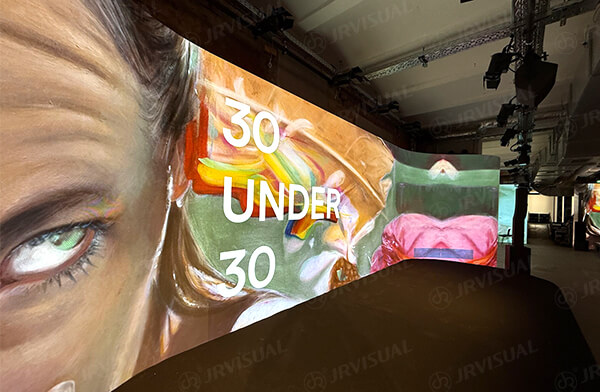
Traditional digital signage has always been a constant tug-of-war between architects’ creative visions and manufacturers’ structural limitations. Standard LED screens are inherently rigid, bulky, and linear. Forcing flat screens into curved surfaces or modern designs creates blind spots and visual disruptions, harming the space’s immersive quality. The advent of flexible LED displays has eliminated these obstacles. By utilising highly flexible, high-strength substrates, this technology allows the screen to blend seamlessly with the architecture. It creates a more natural and fluid visual experience that complements the natural movement patterns of people within the physical environment.
What Sets the Indoor MIP Flexible LED Module Apart?
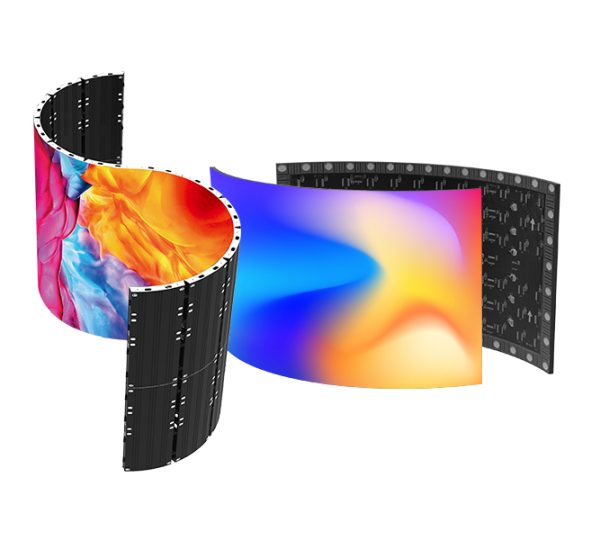
To truly understand the performance advantages of indoor MIP flexible LED modules, one must examine the “MIP” (Micro-LED-in-Package) architecture. This is not just a minor update to LED design, but a fundamental shift in how LEDs are packaged, protected, and deployed. Flexibility Principles: Innovation in PCB and Silicone. The core of these modules consists of a specialised multi-layer flexible printed circuit board (PCB) and a highly elastic silicone mask. These materials are specifically designed to withstand repeated bending. This results in an extremely small minimum bending radius, allowing the screen to wrap around standard building columns or tight corners without causing pixels to “fall off” or circuit fatigue.
MIP Chip Integration: The Advantages of Micro-LED Unlike traditional SMD (Surface Mount Device) technology, MIP technology utilises significantly smaller Micro-LED chips paired with high-precision protective packaging. The miniaturisation of the light source results in substantially larger black areas on the module’s surface. In the field of display technology, larger black areas directly translate to higher contrast and deeper, inky blacks. Visual Consistency and Wide Viewing Angles: Because the Micro-LED chips used in MIP packaging offer exceptional uniformity, this display delivers outstanding colour accuracy and brightness consistency across the entire curved surface. Lower-cost flexible displays do not perform as well; when viewed from sharp angles, they typically exhibit shadowing or colour shifts. The MIP structure eliminates this issue, ensuring a perfect image from any angle.
Durability and Thermal Management: Although the modules are ultra-thin and flexible, they are specifically designed for demanding 24/7 industrial applications. They are equipped with advanced heat dissipation channels to ensure the flexible substrate remains cool during operation. By maintaining a lower operating temperature, indoor MIP flexible LED modules ensure a longer service life.
Where Does a Flexible LED Display Add the Most Value?
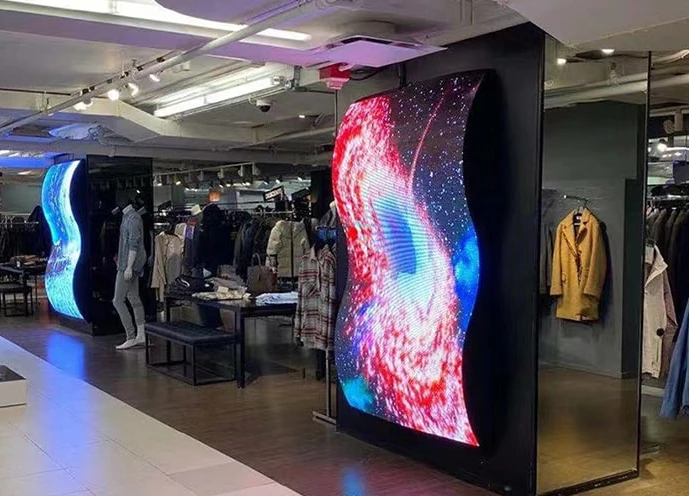
Where does a Flexible LED Display truly outshine the competition? Consider the high-stakes environment of an automotive showroom. A curved screen can mirror the aerodynamic lines of a luxury vehicle, creating a psychological sense of speed and fluidity even when the car is stationary. In the world of luxury retail, these modules are utilised to create “digital sculptures”—fixtures that serve as both artistic lighting and high-impact branding platforms.
Imagine a shopping mall where information doesn’t just sit on a sign but wraps around the elevators and flows along the bulkheads of the ceiling. Furthermore, in public transport hubs like international airports, the Indoor MIP Flexible LED Module is being used to create 360-degree information pillars. This lets travellers access flight data or safety alerts from any direction, reducing congestion around a single flat display. It turns a functional necessity into a breathtaking architectural centrepiece.
Implementing a MIP Flexible LED Module project requires a more nuanced approach than simply buying panels off a shelf. Because these screens are designed to follow custom, often irregular shapes, the mounting frame must be precision-engineered. Most high-end installations utilise a magnetic mounting system. The modules “snap” onto a pre-curved steel structure with magnetic precision, speeding up installation and enabling easy front-access maintenance.
However, this also means that the building’s initial structural measurements must be perfect. There is very little room for error when mapping pixels to a 3D curve. Another key consideration is content mapping. Since the final display is rarely a standard 16:9 rectangle, creative teams must design content that fits the installation’s specific geometry. When the video pixels and the hardware’s shape align perfectly, the effect becomes truly holographic. The digital content no longer looks like a video on a screen; it appears as though the wall itself has come to life.
Why Invest in Indoor MIP Flexible LED Modules?
Choosing the right display technology is a long-term, rewarding investment in the lasting image and atmosphere of a space. Indoor MIP flexible LED modules uniquely combine mechanical durability, unparalleled visual effects, and complete creative freedom. As physical environments become more interactive, seamlessly integrating light into architectural design is no longer a luxury—it’s a competitive necessity. By moving away from traditional rectangular displays and embracing high-resolution flexible solutions, your brand can stay ahead of the curve. You won’t just be presenting an image to visitors. Instead, you’ll offer them a spatial experience that is as modern, fluid, and memorable as the world they live in!