
A curved architectural surface does not automatically require a flexible LED module. For some projects, a conventional cabinet system assembled at controlled angles can create the required curve with simpler installation and service. Other projects involve columns, waves, very small radii, or continuously changing geometry where rigid cabinets cannot follow the shape accurately. Choosing a flexible LED screen for irregular shapes therefore starts with geometry, not with the assumption that one LED construction method is always better. This comparison helps project teams decide which approach fits the radius, viewing distance, supporting structure, maintenance method, and visual target.
Flexible LED Screen for Irregular Shapes: Start With the Geometry
Ask for an accurate drawing of the finished LED surface.
The drawing should identify:
- Overall width and height
- Radius or multiple radii
- Convex and concave sections
- Transition points
- Corners
- Openings
- Finished surface tolerance
- Viewing directions
A simple cylindrical wall may be possible with angled rigid cabinets. A narrow column, wave-shaped feature, or surface with changing curvature is more likely to require a flexible LED screen system. The important question is not whether the project is “curved.” It is how the radius changes across the complete display.
When Is a Curved LED Cabinet the Better Choice?
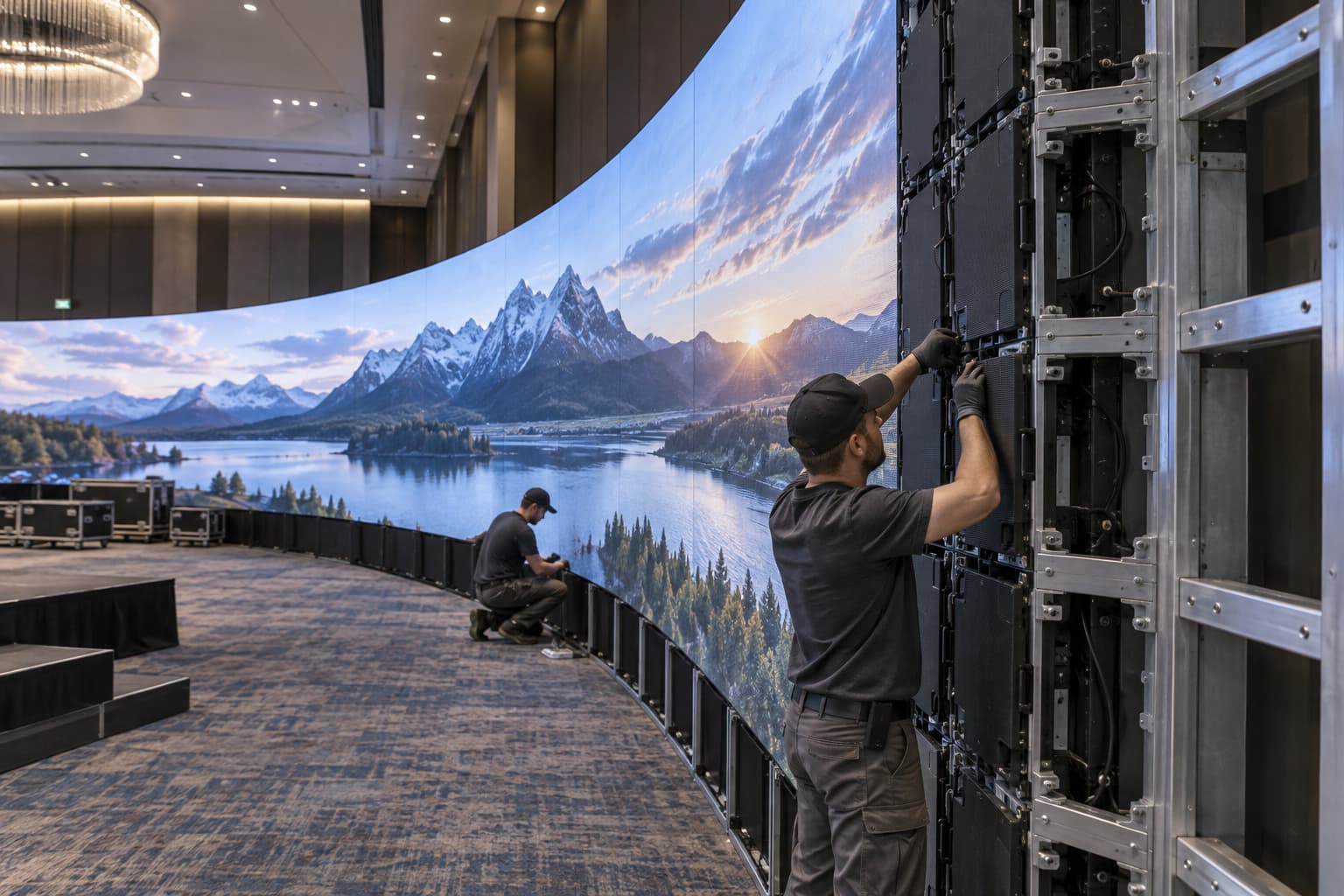
Curved cabinets are useful when the required geometry is predictable. You can manufacture or install cabinets with specific angles between sections, forming a large-radius concave or convex wall.
This approach can provide several project advantages:
- Defined mechanical alignment
- Repeatable cabinet dimensions
- Familiar installation methods
- Clear rear-service access
- Easier removal of complete cabinet sections
- Strong structural integration
For a large conference hall or stage backdrop with a consistent radius, this may be more practical than using flexible modules across the entire surface. A cabinet solution also makes sense when the visual design does not require the LED surface to follow every architectural contour.
When Does a Flexible LED Screen for Curved Walls Make More Sense?
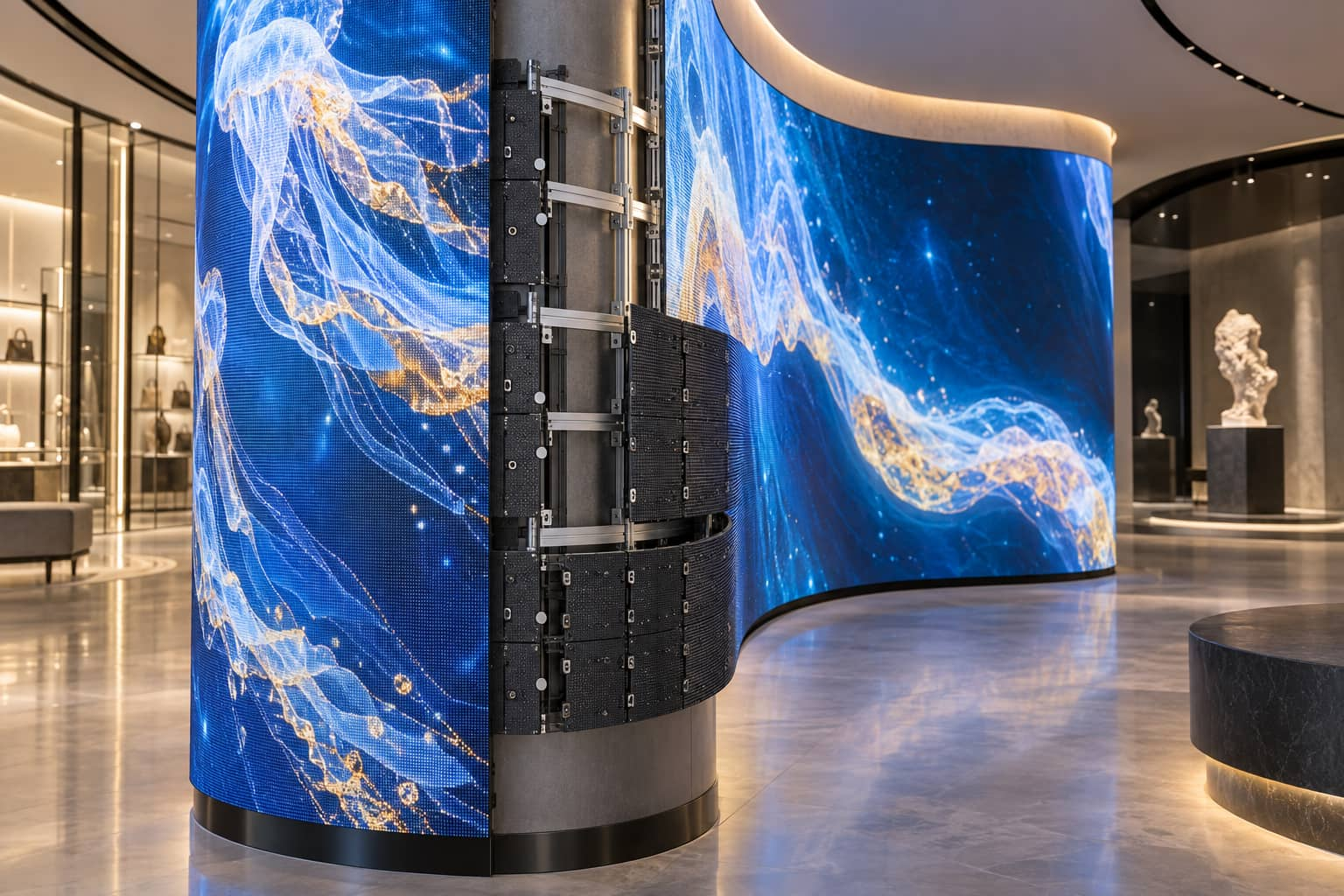
A flexible LED screen for curved walls becomes valuable when conventional cabinets create visible facets or cannot match the required radius. Flexible LED modules can follow supporting structures designed around cylinders, arcs, waves, and other non-flat surfaces.
Projects may include:
- Retail columns
- Curved storefront features
- Museum installations
- Exhibition structures
- Circular displays
- Sculptural LED surfaces
- Architectural feature walls
The supporting structure remains critical. A flexible module does not automatically create an accurate curve. The finished LED surface follows the mechanical structure behind it. This means the steel or aluminum structure must be manufactured with appropriate dimensional accuracy. For indoor projects requiring close integration with custom structures, an indoor flexible LED display can support geometries that are difficult to achieve with conventional rectangular cabinets.
Flexible LED vs Curved LED Screen: Compare Minimum Radius
The first engineering comparison is radius. Do not ask only whether a product is “flexible.” Ask the supplier for the supported bending range or minimum recommended radius for the selected module. Then compare it with the actual project geometry. A module that works well on a broad curved wall may not suit a small-diameter column. At the same time, bending a module close to its physical limit simply because it is possible is not always the best project decision.
The project team should consider:
- Module dimensions
- PCB construction
- Mask or surface design
- Mounting method
- Magnetic system
- Module-to-module alignment
- Long-term mechanical stress
A physical sample test is useful when the geometry is unusually tight or visually sensitive.
Flexible LED Display for Irregular Surfaces Needs an Accurate Structure
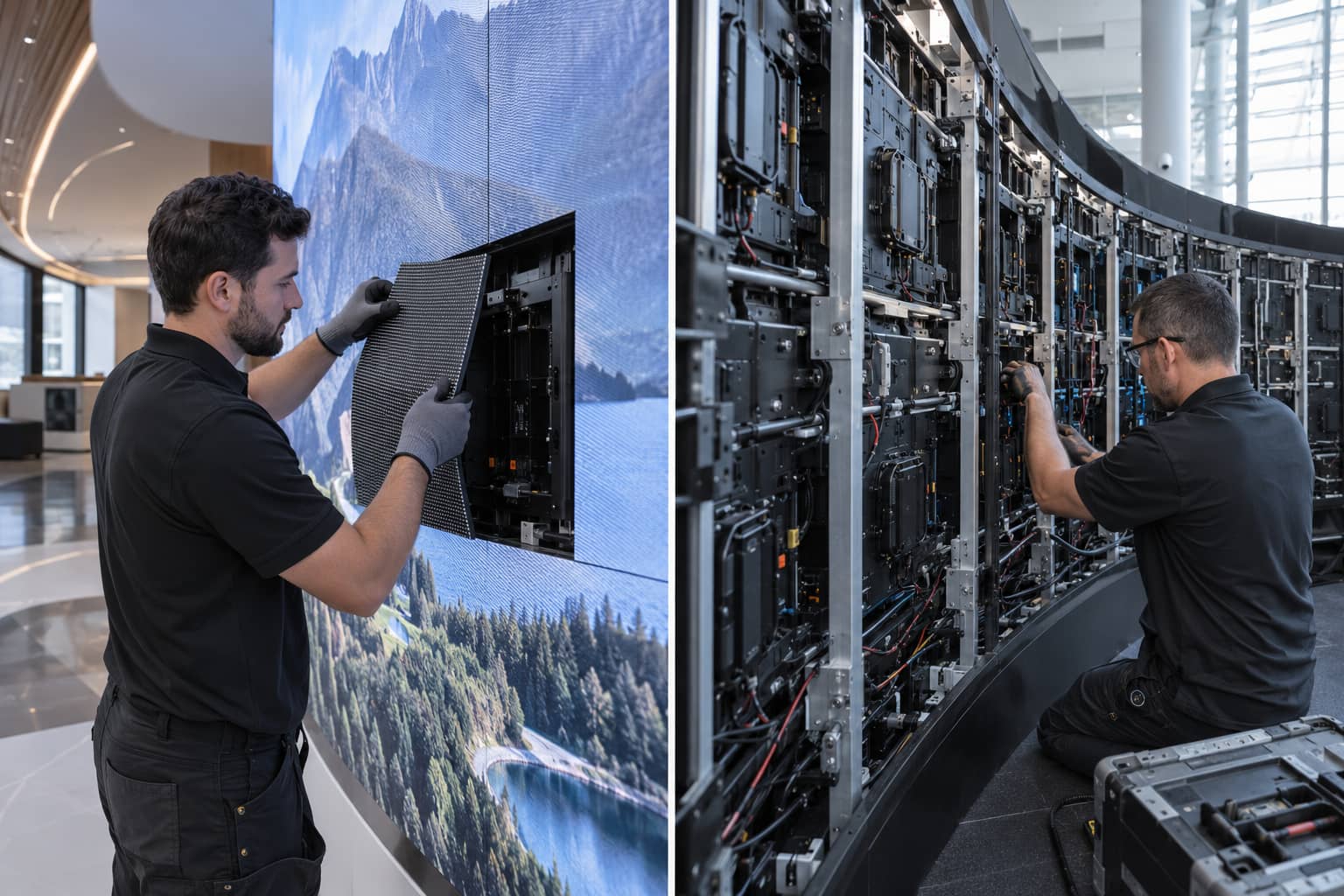
The rear structure determines whether the finished display looks smooth.
For a flexible LED display for irregular surfaces, small frame errors can show up as uneven module alignment, inconsistent seams, or visible changes in curvature.
Before manufacturing, the supplier should receive either:
- Accurate CAD drawings
- 3D model data
- Site measurements
- Physical templates for unusual shapes
For complex projects, the LED supplier and fabricator should agree on reference dimensions and installation tolerances.
Do Not Solve Geometry Only in the LED Layer
A common project error is asking the LED installer to compensate for an inaccurate structure during final installation. That can lead to inconsistent gaps, uneven magnet contact, difficult servicing, or local stress on modules. A better approach is to correct the supporting surface first and use the LED modules to follow a structure already within the required tolerance.
Compare Service Access Before Selecting the Screen Type
A visually impressive surface can become expensive to operate if modules cannot be removed after installation.
Ask how technicians will reach:
- LED modules
- Power supplies
- Receiving cards
- Hub boards
- Signal connections
- Structural fixings
Many flexible systems use front magnetic service, which can be valuable when there is no rear corridor. However, the project still needs enough working space to extract modules and reach internal components. Curved cabinet systems may provide more conventional rear access when the building design allows it. Neither approach is automatically better. The correct choice depends on how the screen will actually be maintained.
Check Electrical and Product Safety Requirements
Custom geometry should not cause the project team to ignore electrical safety, heat management, cable protection, or component accessibility. IEC 62368-1 is an international safety standard covering audio/video and information and communication technology equipment. It uses an energy-source and safeguard approach to equipment safety. Project teams should determine which product and local installation standards apply to their specific market and system. The current publication is available from the International Electrotechnical Commission. This is particularly relevant when custom display structures alter enclosure conditions or place electrical components inside narrow architectural cavities.
Outdoor Irregular Shapes Add Another Decision Layer
Outdoor projects must consider water protection, drainage, ventilation, sunlight, temperature, and wind exposure in addition to geometry. A flexible indoor module should not be selected merely because it can create the required shape. For exterior curved surfaces, evaluate a dedicated outdoor flexible LED display and confirm how the structure handles environmental protection. The waterproofing strategy should cover the entire assembly, not only the LED module.
A Simple Selection Matrix
Use these questions before requesting a quotation.
| Project Condition | Flexible Module | Curved Cabinet |
|---|---|---|
| Very small radius | Often suitable | May be limited |
| Complex changing curve | Strong option | More difficult |
| Large constant radius | Suitable | Often practical |
| Front service required | Often suitable | Depends on cabinet |
| Conventional rear access | Possible | Strong option |
| Highly custom architecture | Strong option | Project dependent |
This is only a starting framework. You must still check the actual module radius, cabinet angle, pixel pitch, structure, and maintenance requirements.
FAQ About Flexible LED Screens for Irregular Shapes
Can flexible LED modules create any shape?
No. Every module has physical bending and installation limits. The supporting structure, module dimensions, cable routing, and service access also constrain the geometry.
Is a flexible LED module always better for curved walls?
No. A large, constant-radius wall can be built efficiently with curved or angled cabinets. Flexible modules are particularly useful when tighter or more complex geometry is required.
What drawings should a buyer send to the LED supplier?
Provide dimensions, radius information, CAD drawings or a 3D model, viewing distance, installation environment, structural information, and the intended maintenance method.
Should you build the curved structure before selecting the LED system?
The two should be coordinated. Module dimensions and bending capability influence the structure, while the final architectural geometry determines what LED configuration is practical.
Choose the Construction Method From the Shape Backward
Decide between a curved cabinet and a flexible LED screen for irregular shapes by working backward from the physical project requirements. Define the geometry first. Then verify radius, module size, supporting structure, service access, environment, and installation tolerance. This prevents a common problem in customized LED projects: selecting the screen type first and trying to force it onto an architectural shape later. For irregular installations, the best system reproduces the intended geometry while remaining structurally practical, serviceable, and consistent across the entire display surface.