
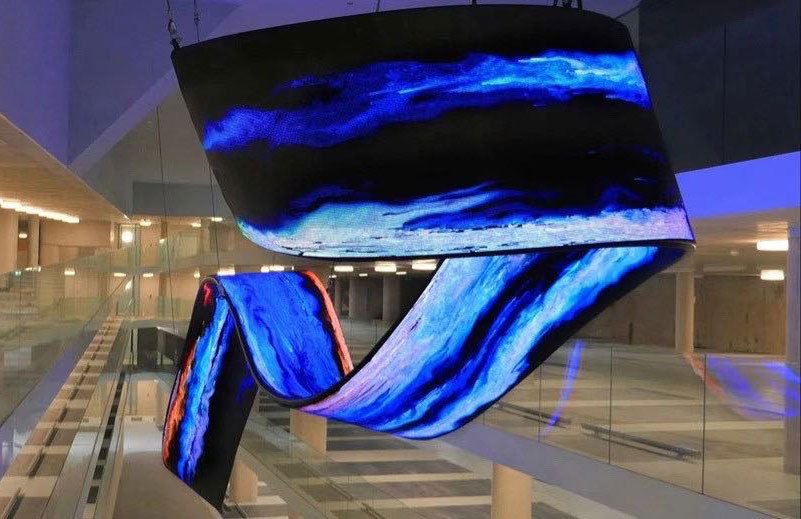
Not on every curve — but on most of them, yes. A foldable LED screen can conform to columns, arcs, concave walls, and irregular ceilings that rigid panels can’t reach. The limiting factor isn’t the technology itself. It’s whether the surface geometry stays within the screen’s minimum bend radius and whether the substrate matches the environment. Get those two things right, and curved surfaces stop being a constraint.
How a Foldable LED Screen Bends Without Breaking?
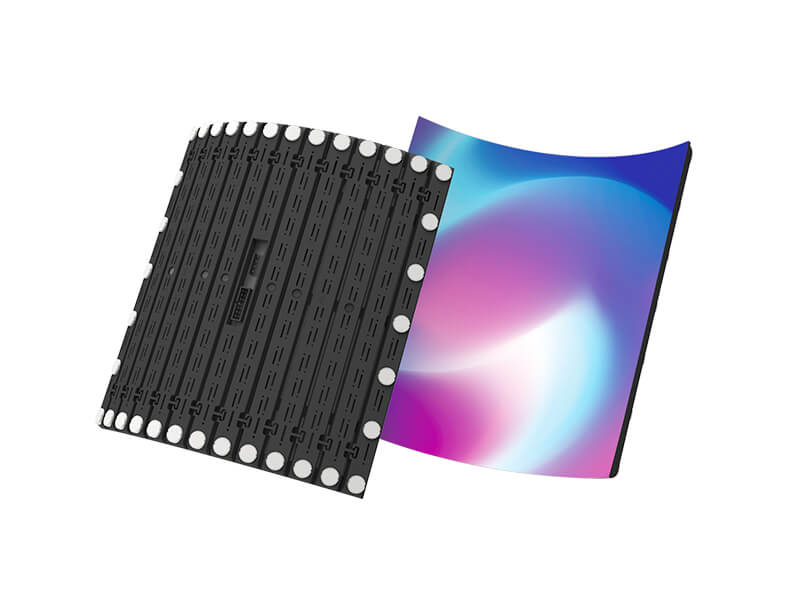
The flexibility comes from the substrate — the base layer on which the LED chips sit. Standard flexible LED panels use a soft PCB base. It handles gentle curves well but has a practical limit on how tight a bend it can safely sustain. Silicone-based substrates go further. They distribute mechanical stress more evenly across the panel surface. That’s why MIP-based modules achieve minimum bend radii that soft PCB formats can’t match. Minimum bend radius is the number that matters most. A standard bendable LED screen can safely curve to a radius of around 500mm. MIP-based modules — like the iSoft MIP — compress that down to approximately 200mm. That opens up tight column wraps and sharply curved architectural features that would fracture a standard module.
GOB (Glue-on-Board) protection adds another layer of resilience. A resin coat encapsulates each LED chip, absorbing micro-vibrations and stress shifts that occur every time the panel flexes. For installations involving repeated handling or outdoor thermal cycling, GOB coating is worth specifying. It significantly extends the panel working life under mechanical load. Quality flexible LED screens sustain at least 10,000 bend cycles without measurable LED failure or connector degradation. That figure is the industry benchmark. Any supplier who can’t provide test data against it is worth questioning before the order goes through.
Where a Foldable LED Screen Performs Best?
Architectural columns are the most established use case. A foldable LED screen wraps around structural pillars in hotel lobbies, airport terminals, and retail flagships — turning load-bearing elements into full-surface content displays. The iSoft Max handles this configuration at P2.6mm pixel pitch. Its silicone substrate maintains consistent colour across the entire curved surface without visible seam lines. Curved stage backdrops are another strong fit. Live events and broadcast studios use flexible LED panels to create concave backgrounds that follow the stage’s arc. Setup runs faster than rigid modular walls, and the geometry possibilities are wider.
Retail curved window installations combine transparency and flexibility. A bendable LED screen on a curved storefront glass surface runs dynamic content while keeping the store interior visible. Rigid formats can’t replicate that configuration at all. Irregular ceilings and overhead installations benefit from the format’s low-weight profile. A flexible display module at 6–8 kg/m² imposes far less structural load than a comparable rigid cabinet array. That matters when the mounting surface has limited load capacity.
How to install on a curved surface?
Before installation begins, confirm the direction of the curve. Concave surfaces place tension on the outer panel face. Convex surfaces stress the inner substrate layer instead. Not all flexible LED screens handle both directions equally, so specify the curve geometry to the supplier during sampling — not after delivery. Structural load needs verification early. A foldable LED screen installation with cabling, brackets, and power supplies typically runs 8–12 kg/m². Confirm that the mounting surface can carry that load before finalising the design. Retrofitting structural support after the screen arrives on site is expensive.
Cable routing is where most installation errors happen. Run cables parallel to the direction of curvature — never across the bend point. Cables crossing the flex axis create stress concentrations at connector contacts. Those contacts degrade over time, resulting in intermittent signal loss. That failure mode develops slowly and is hard to diagnose, so correct routing at installation costs nothing compared to fixing it later. For outdoor installations, build thermal expansion gaps into the mounting frame.
Aluminium frames expand approximately 23 µm per meter per degree Celsius. In a climate with a 40°C seasonal range, that movement accumulates on a large installation. A frame without expansion gaps stresses the panel edges progressively over time. Plan maintenance access before mounting. A column wrap with no access panel requires full disassembly to reach any component behind the screen. Design the service point into the installation from day one.
Not all surfaces are suitable
Some surfaces fall outside the range that any flexible LED screen can safely handle. The most common case is a curve radius tighter than the module’s rated minimum. Forcing a panel beyond its bend limit causes substrate fracture — often appearing as dead pixel clusters weeks after installation, not on day one. Substrate mismatch is the second failure point. An indoor-rated flexible display module used outdoors lacks the IP rating and thermal tolerance the environment demands. Moisture ingress and UV exposure degrade the substrate faster than the LED chips. The screen fails from the outside in.
Control system incompatibility is overlooked more often than it should be. A foldable LED screen paired with an incompatible signal processor needs additional bridging hardware. That hardware adds cost, latency, and another potential failure point. Verify compatibility before signing the purchase order. Finally, treat missing bend-cycle test data as a red flag. That data exists for any properly tested product. Its absence usually means the testing never happened.
A Foldable LED Screen Works — When the Conditions Are Right
Most curved surfaces work well with current flexible LED display technology. Columns, arcs, concave walls, curved ceilings — the format handles them all when the specification matches the geometry. Failures trace back to specification errors, not technology limits: the wrong bend radius, the wrong substrate, the wrong environment rating, or a control system that nobody verified before purchase.
A foldable LED screen with the right specs runs reliably for years. The questions that determine fit — minimum bend radius, substrate type, IP rating, and mounting load — all have answers before production starts. For project-specific guidance, the JR Visual team reviews installation drawings and surface geometry before any screens ship. Getting that conversation right early is what keeps the installation from becoming a retrofit.