
Stadium entrances and concourses handle thousands of visitors within short periods. These areas must communicate entry instructions, seating directions, event schedules, safety messages, sponsor advertisements, and live updates without interrupting crowd movement. Flat LED cabinets work well on standard walls, but many stadiums include curved facades, rounded columns, arches, irregular entrance structures, and circular concourse areas. Outdoor Flexible LED Displays can follow these architectural surfaces while maintaining a continuous digital image.
A flexible display can turn structural areas that previously carried static signs into active communication and advertising spaces. It can also form part of a complete sports LED display solution covering visitor guidance, commercial advertising, event information, and venue operations. However, buyers should not select a screen only by pixel pitch or price per square meter. The final system must match the stadium structure, viewing distance, weather exposure, maintenance conditions, and public safety requirements.
Where Can Outdoor Flexible LED Displays Be Installed in Stadiums?
Outdoor Flexible LED Displays can support both stadium operations and commercial advertising. Their ability to form curved and custom shapes allows stadium operators to use architectural areas that are difficult to cover with rigid LED cabinets. A screen near the main entrance may display event branding, entry times, ticket information, sponsor content, or security instructions. Displays inside concourses can guide spectators toward seating zones, food areas, restrooms, merchandise stores, and emergency exits.
Curved Facades, Entrance Columns, and Concourse Walls
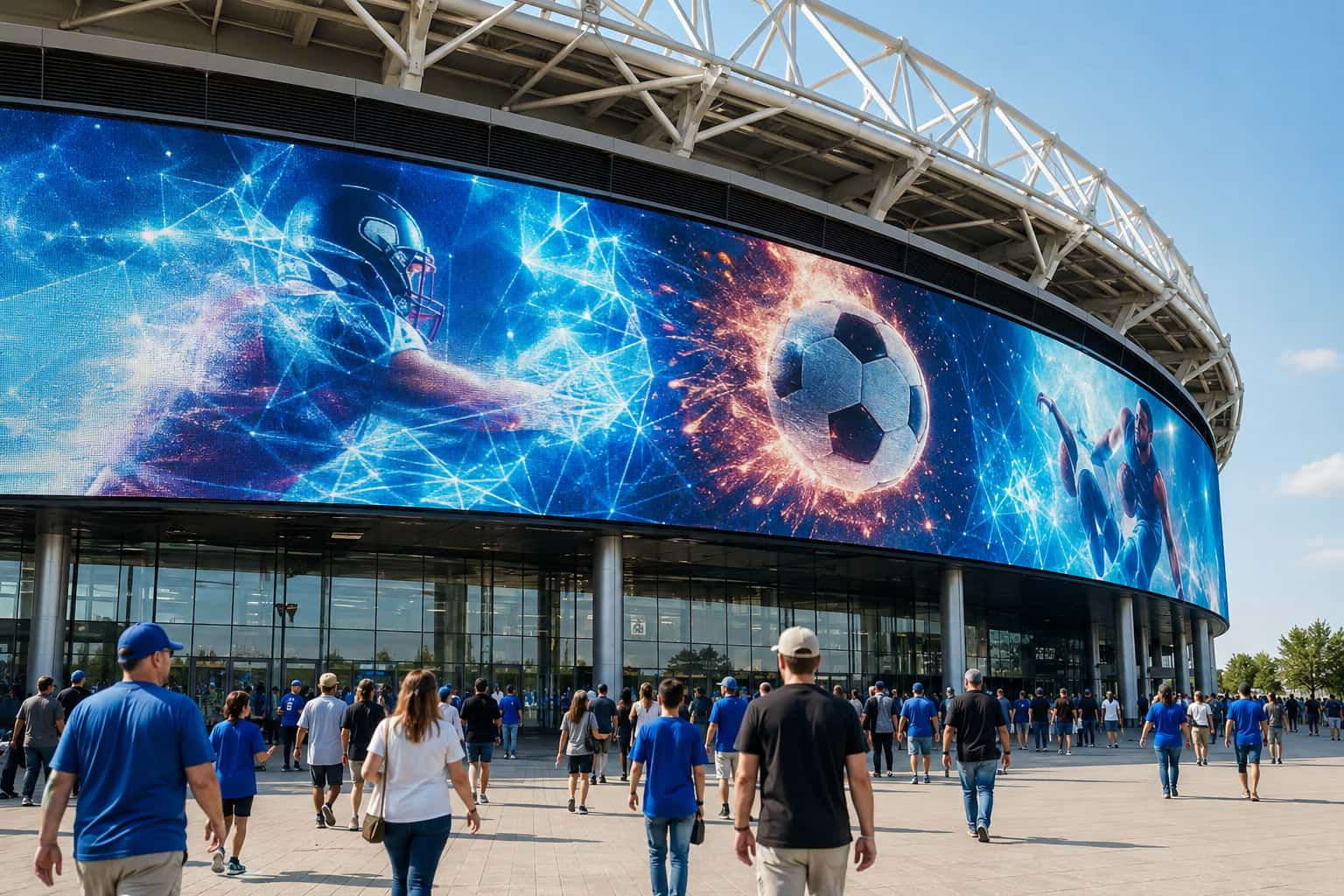
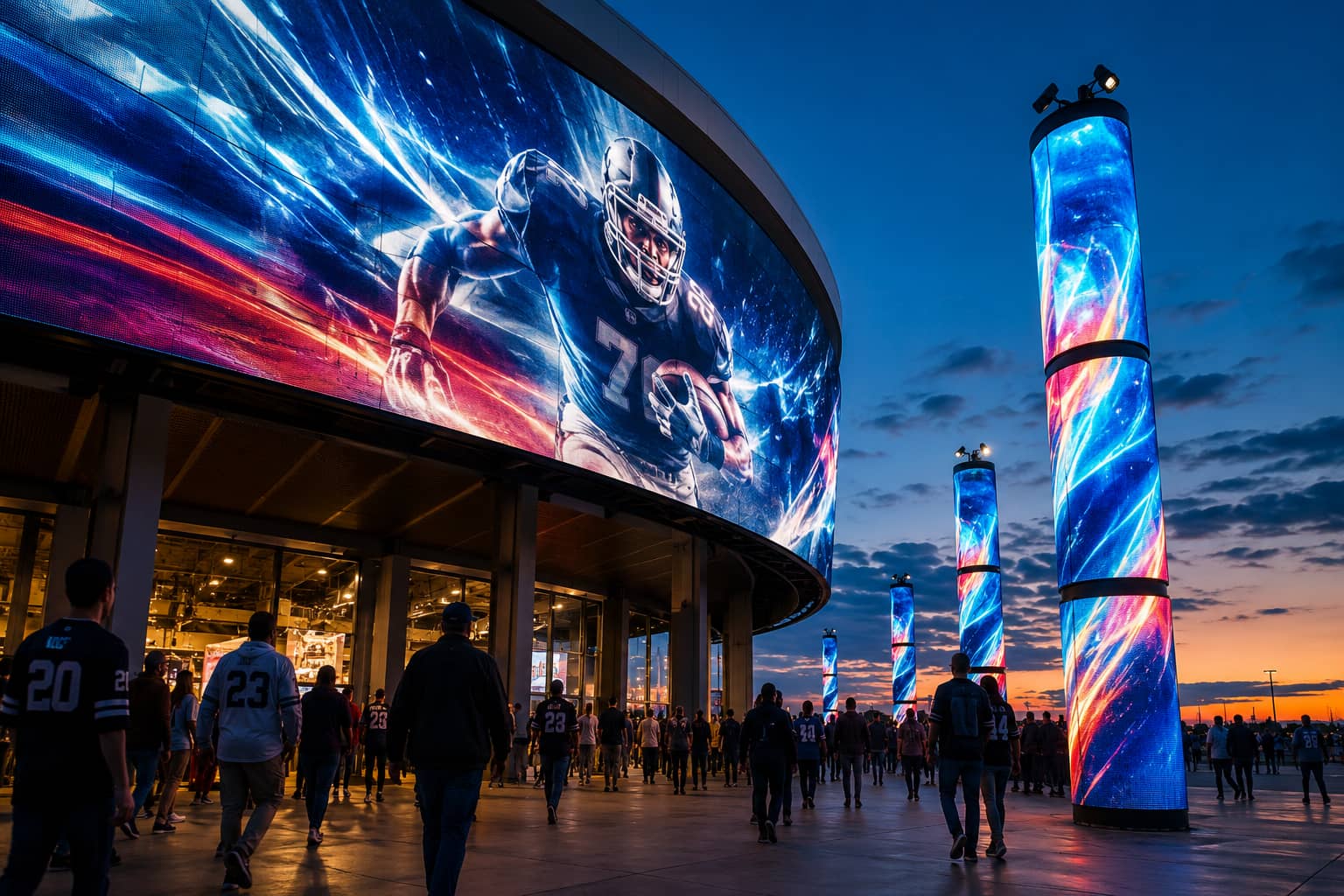
Suitable installation positions include curved entrance facades, arched gateways, irregular walls, round structural columns, ticketing areas, security inspection zones, semi-open concourses, retail areas, and merchandise zones. Columns are suitable for flexible modules because the modules can wrap around the supporting structure. A properly designed flexible LED display screen can create continuous content around a cylindrical column without the sharp corners produced by standard cabinets. Curved entrance walls can also become large digital landmarks. A curved LED screen installed across an entrance facade can display team branding, event campaigns, sponsor advertisements, crowd instructions, and live announcements. The supplier must match the module bending range and supporting frame to the required concave, convex, or cylindrical shape.
Assess the Stadium Entrance and Concourse Environment
Every stadium project should begin with a site assessment. Architectural drawings may not reveal surface irregularities, maintenance restrictions, unexpected viewing angles, or exposure to rain and sunlight. The project team should measure the structure and observe how spectators move through the area. A display designed for people standing in a ticket queue needs different specifications from a screen viewed by visitors walking quickly through a wide concourse.
Measure Curvature, Viewing Distance, and Weather Exposure
The site survey should record the installation width and height, curve direction, column diameter, required bending radius, screen height, audience movement direction, and nearest and farthest viewing distances. The project team should also examine direct sunlight, rain exposure, humidity, local temperature changes, dust, and wind conditions. These factors affect brightness, waterproofing, heat dissipation, structural support, and long-term maintenance. For a round column, the supplier should calculate the complete circumference and confirm whether the module dimensions can close the circle without leaving a large gap or creating an uneven seam.
A concourse beneath a roof should not automatically be treated as an indoor environment. Wind-driven rain, reflected sunlight, humidity, and airborne dust may still reach the screen. Buyers comparing LED display flexible solutions should therefore select the product structure according to the actual installation conditions.
Choose the Right Pixel Pitch and Brightness
Pixel pitch affects image detail, viewing distance, screen resolution, and total project cost. Selecting the smallest available pixel pitch does not automatically improve the installation. It may increase cost without producing a visible benefit for spectators. Brightness also requires careful selection. A flexible display that looks clear inside a showroom may become difficult to read when installed near a sunlit stadium entrance.
Match Display Specifications to Viewing Conditions
Entrance information areas often display maps, ticket notices, security instructions, and seating directions. Because spectators may stand relatively close to these screens, the project may require a finer pixel pitch that keeps text and graphics readable. Concourse advertising walls usually serve audiences at a medium viewing distance. The selected pixel pitch should provide clear sponsor and promotional content without adding unnecessary resolution and cost.
Large exterior facades and entrance landmarks are normally viewed from farther away. For these screens, overall size, brightness, contrast, and long-distance visibility may matter more than very fine image detail. Covered entrances generally need less brightness than facades exposed to direct sunlight. Semi-open concourses require enough brightness to remain clear as daylight changes, while sun-facing screens require stronger daytime visibility. Automatic brightness adjustment can maintain readability during the day and reduce glare, energy use, and visual discomfort at night.
Before approving the specification, buyers should test the actual content expected to appear on the display. Text, team logos, directional graphics, videos, sponsor advertisements, and emergency messages may each place different demands on resolution and contrast.
Evaluate the Flexible Display Structure and Maintenance
Outdoor Flexible LED Displays rely on more than flexible modules. The supporting cabinet, steel frame, fixing system, power distribution, data connections, and maintenance access all affect long-term reliability. The screen should form a smooth curve without visible steps, gaps, dark lines, or module misalignment. Buyers should request detailed drawings showing how the display connects to the stadium wall, column, or supporting steel structure.
Compare Modules, Fixing Methods, and Service Access
The technical proposal should clearly state the minimum bending radius, supported curve directions, module dimensions, supporting frame design, mechanical safety measures, power supply locations, receiving card positions, cable routes, and module replacement method. Magnetic attachment can speed module removal, but magnets should not serve as the only safety measure in a public outdoor area. The installation should also include mechanical locks, anti-drop components, safety cables, or another secondary fixing method.
Maintenance access requires early planning. A curved LED screen mounted directly against a concrete wall may require full front maintenance. A cylindrical display may need removable panels, hidden access doors, or an internal service space. Technicians should be able to replace a module, power supply, receiving card, or cable without dismantling a large section of the screen. This reduces repair time and helps stadium operators restore the display before the next event.
Check Outdoor Protection and Public Safety
Stadium entrances and concourses are high-traffic public areas. A display failure can affect visitor communication, while loose components, water entry, overheating, or exposed electrical parts can create safety risks. A complete outdoor LED display project should address weather protection, thermal management, structural support, electrical design, drainage, and maintenance access before installation begins.
Review Waterproofing, Heat Dissipation, and Structural Safety
The screen design should prevent rainwater and wind-driven moisture from reaching electrical components. Power boxes, signal connectors, and cables require suitable sealing, while the rear structure needs drainage paths that prevent water from collecting behind the modules or at the bottom of the display. Heat may build up inside cylindrical screens and enclosed curved structures. The supplier should calculate the expected thermal load and provide ventilation or another heat-control method that protects modules, power supplies, and control equipment during hot weather.
Structural engineers should evaluate the screen weight, supporting frame, wall loading, installation height, and local wind conditions. Screens positioned above stadium entrances or close to pedestrian routes require secure mechanical fixing and documented structural calculations based on applicable wind load requirements. The electrical design should also include protected cable routes, grounding, leakage protection, independent power distribution, fire-resistant materials, and accessible emergency shutdown controls. These measures help the stadium team isolate the system quickly when maintenance or an emergency requires it.
How to Choose Outdoor Flexible LED Displays for Stadium Entrances and Concourses?
A reliable selection process compares complete project solutions rather than individual product specifications. The lowest screen price may exclude the supporting structure, waterproofing, control equipment, power distribution, installation guidance, spare parts, or maintenance access. Buyers should provide the same site information to each supplier so that proposals can be compared consistently. The supplier should understand both the visual objective and the screen’s operational role.
Use a Project-Based Supplier Evaluation Checklist
- Define the screen location, audience, and communication purpose.
- Measure the installation area, curve direction, and column diameter.
- Record the nearest and farthest viewing distances.
- Select the pixel pitch based on the content and viewing conditions.
- Please confirm the suitable brightness for daytime and nighttime operation.
- Review waterproofing, drainage, cooling, and wind resistance.
- Choose front or rear maintenance based on available space.
- Review the steel structure and secondary safety fixing system.
- Confirm electrical protection and emergency shutdown methods.
- Check compatibility with the stadium content control system.
- Please request references for similar outdoor curved display projects.
- Compare warranty coverage, spare parts, training, and technical support.
A complete quotation should list the screen dimensions, pixel pitch, brightness, bending radius, module structure, control system, power system, supporting frame, installation method, maintenance access, spare parts, and warranty coverage. Outdoor Flexible LED Displays can turn stadium entrances and concourses into communication points, digital landmarks, and commercial advertising spaces. The project will perform more reliably when the display specification, flexible structure, outdoor protection, and maintenance plan are developed around the actual stadium environment.