
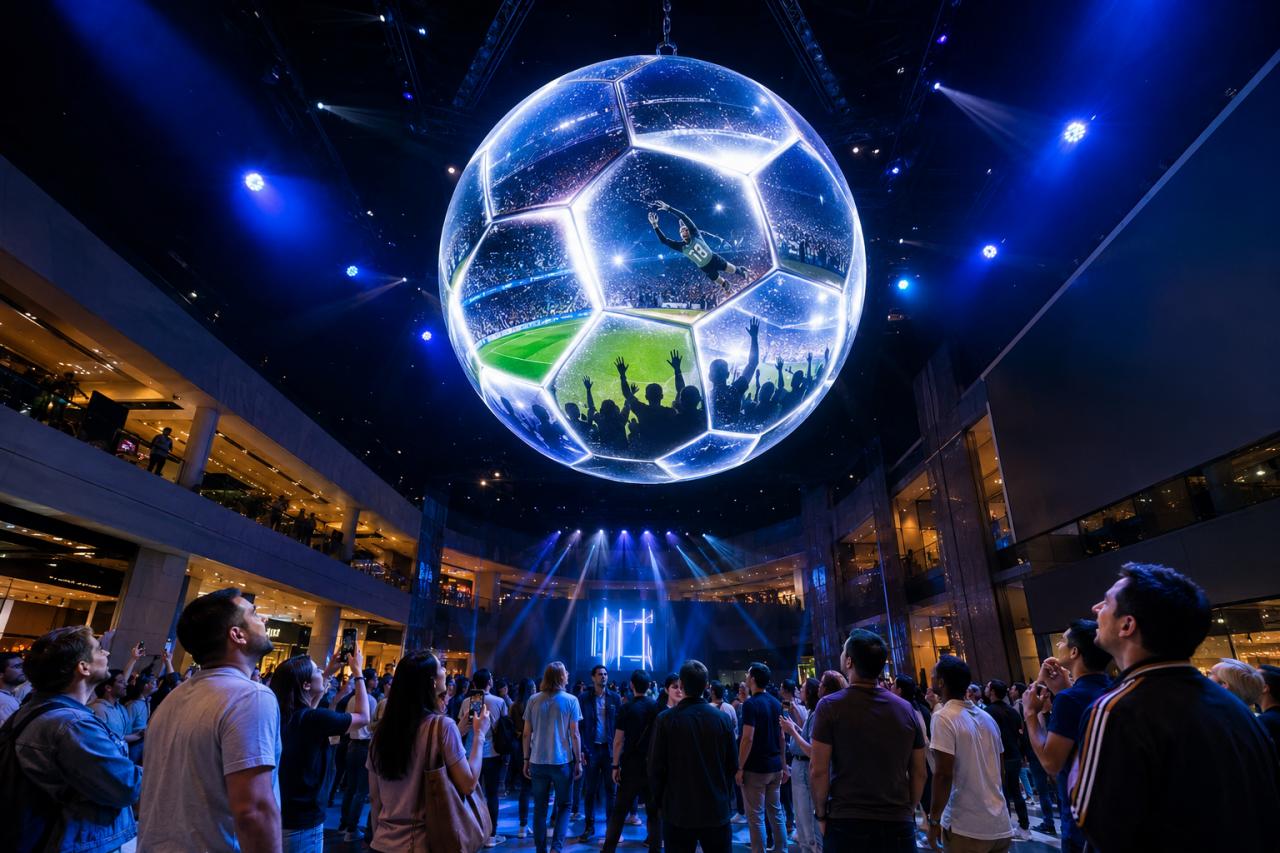
A 360 LED screen is a digital display built around a spherical surface, keeping images visible as viewers move around it. A conventional LED wall normally presents content from one main direction, but a sphere has no single front side. This difference changes the screen structure, pixel layout, video mapping, and the way audiences experience the content. The term 360 LED screen usually refers to an LED sphere rather than a ring of separate flat displays. Flexible or specially shaped LED modules follow the curved structure, creating a continuous visual surface. The result can show planetary graphics, rotating objects, branded animation, and other media designed for viewing from several directions inside the same venue.
What Is a 360 LED Screen?
A 360 LED screen combines an LED display surface with a three-dimensional spherical frame. Each LED pixel emits light directly, so the structure doesn’t need a projector or external projection surface. The screen can operate indoors or outdoors when its modules, structure, and electrical system match the installation site’s environmental conditions. The shape distinguishes a 360 LED screen from other creative LED display solutions, including circular screens, LED floors, domes, and rolling displays. A circular screen remains flat or ring-shaped, while an LED sphere curves in every direction. An LED dome usually places the audience inside or beneath a curved surface rather than presenting a complete external sphere.
How Is the Curved Surface Built?
A 360 LED screen starts with a spherical support frame that sets the final diameter. LED modules attach around this frame in sections, creating the visible pixel surface. The exact module shape and arrangement depend on the diameter and pixel pitch because smaller spheres require tighter curvature than large spheres. Identical flat squares can’t cover a sphere without geometric adjustment, so a 360 LED screen uses carefully arranged modules and structural segments to manage the curve. Manufacturers must control gaps and alignment between sections so bright lines, dark seams, or irregular shapes do not interrupt the image as content moves around the surface.
How Does a 360 LED Screen Produce a Complete Image?
A 360 LED screen receives video data through a control system that assigns part of the image to each section of the sphere. Receiving components distribute the correct pixel information to the LED modules, while the processor coordinates resolution, refresh, and playback. The complete picture appears when every section displays its assigned part at the same time. Unlike a flat display with a simple rectangular coordinate grid, a 360LEDd screen needs a custom pixel map that describes pixel locations across the curved surface. Media software uses this map to transform a flat source file into content that can wrap around the sphere. The screen resolution and mapping template must match the physical product configuration.
Why Pixel Pitch Changes Image Detail
Pixel pitch measures the distance between adjacent pixels on a 360 LED screen. A smaller pitch places more pixels within the same surface area and can produce smoother detail at close viewing distances. A larger pitch uses fewer pixels and may suit a sphere viewed from farther away, especially when the content contains broad shapes instead of small text. JR Visual lists indoor 360 LED screen options with pixel pitches of 1.2 mm, 1.5 mm, 1.8 mm, 2 mm, and 2.5 mm. Outdoor options include 4 mm and 5 mm. Useful resolution depends on diameter and pitch because a larger sphere has more surface area to cover. The AVIXA information on display image size and viewing position explains why viewer distance affects visible detail.
How Does Spherical Content Mapping Work?
Content mapping converts ordinary video into a format that fits a 360 LED screen. Designers often begin with a flat working canvas supplied for the specific display configuration. Software then wraps that canvas around the spherical pixel map, placing each region of the source image on the corresponding area of the physical screen. Distortion becomes an important concern because a 360 LED screen narrows toward the top and bottom. A face, logo, or line of text may stretch if it moves through these zones. Designers usually keep important elements closer to the main horizontal viewing area, repeat logos around the sphere,e and test the animation from several audience positions before delivery.
Hanging and Floor-Standing Structures
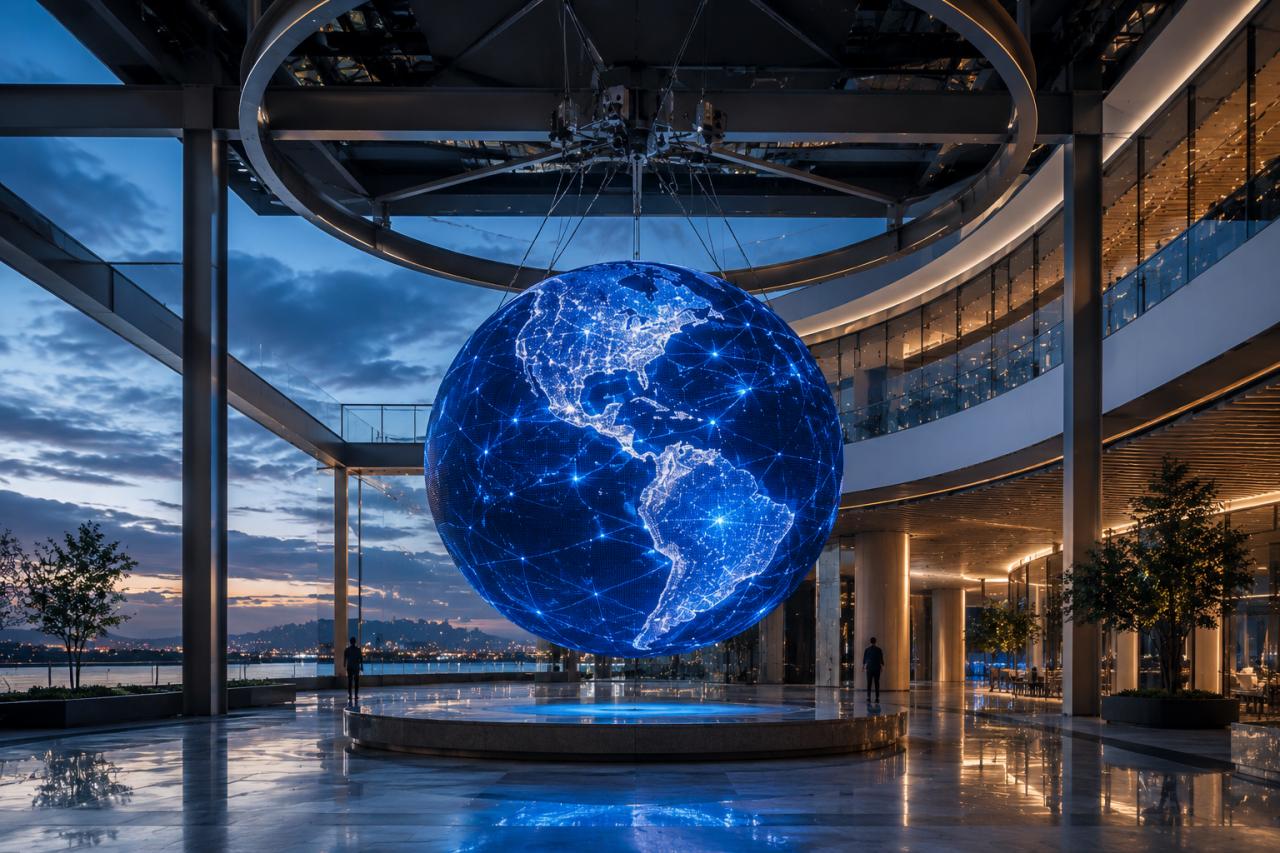
A hanging 360 LED screen attaches to an overhead support system, leaving the floor area open. This arrangement can improve visibility in atriums, exhibition halls, and event venues. The installation requires appropriate rigging points, load review, a planned hanging height, and organised routes for power and signal cables. A floor-standing 360 LED screen uses a stable base to support the spherical structure from below. This format can simplify access for some indoor projects, but the base occupies floor space and must remain clear of visitor traffic. The LED Sphere | Rental and Fixed Installation page shows that both installation formats can support different site layouts.
Where Is a Sphere LED Screen Used?
A 360 LED screen works well when a venue needs a central visual object rather than a front-facing information panel. Museums and science centres can show planets, geographic data, or rotating models. Shopping malls can suspend a sphere inside an atrium, while exhibitions and corporate events can use one for branded motion graphics that remain visible from several aisles. The subject matter should suit the geometry of a 360 LED screen. Global data, rotating products, particles and abstract motion naturally follow a spherical surface. Detailed schedules, long paragraphs and tables are easier to read on flat screens. Reviewing other LED display products helps designers match each content type to a display shape that presents it clearly.
How a 360 LED Screen Differs From a Flat Display?
A flat video wall provides an important point of comparison. For a 360 LED screen, the flat wall supports standard rectangular media, predictable text placement, and one main viewing direction. The sphere supports movement around the display and creates a stronger three-dimensional form, but it requires custom mapping and more careful distortion control.
A 360 LED Screen Combines Structure, Pixels, and Content
A 360 LED screen works by coordinating a spherical frame, curved module arrangement, pixel mapping, control equipment, and purpose-built media. Its value comes from presenting images around a complete object instead of facing viewers in one direction. Venue dimensions, viewing distance, and content determine the final results. Project teams can contact JR Visual for product details or a configuration tailored to a specific space.